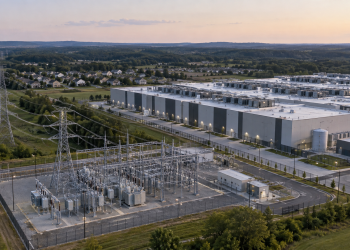
Data center electricity is the single most important operating input for most facilities, and it is the main reason data center growth is now closely tied to utility planning. As cloud services expand and AI workloads scale, electricity demand becomes a core constraint that influences where data centers can be built and how quickly they can come online.
This guide explains what data center electricity really means, how power use is measured, what drives it, and why it matters for budgets, reliability, and communities.
In one sentence: Data center electricity
Data center electricity is the continuous power required to run servers, networking, storage, cooling, and uptime systems, measured as demand (MW) and energy (MWh) and shaped by reliability requirements.
Power vs energy: the simplest way to understand data center electricity
Electricity conversations can get confusing because people mix up power and energy. Data centers involve both.
- Power (kW or MW) is the rate of electricity use at a moment in time. Utilities care about peak MW because it affects grid capacity.
- Energy (kWh or MWh) is the total electricity used over time. Operators care about MWh because it drives the bill.
Example: A facility drawing 50 MW continuously will use 50 MW x 24 hours = 1,200 MWh per day.
For foundational context, see what is a data center and how data centers work.
What uses electricity inside a data center
Most electricity in a data center ultimately turns into heat. That is why power and cooling are linked. The main electricity users include:
- IT equipment: servers, GPUs, storage, and network switches.
- Cooling systems: fans, pumps, chillers, cooling towers, or liquid cooling loops.
- Power delivery: transformers, switchgear, UPS systems, and power distribution units.
- Uptime support: controls, monitoring, security, lighting, and fire suppression support equipment.
For a dedicated explainer, see why data centers use so much electricity and how data center cooling systems work.
Why data center electricity demand is rising
Several trends are pushing demand higher even when facilities become more efficient:
AI and high-density computing
AI training and inference can drive much higher rack densities than traditional enterprise workloads. Higher density means more power per rack and greater cooling demand, which raises total electricity needs for the site.
See how AI and cloud drive data center growth.
More always-on digital services
Streaming, enterprise SaaS, remote work tooling, and digital payments all push more compute into data centers. Even small growth rates compound quickly at global scale.
Reliability and redundancy
Higher uptime expectations can increase supporting power overhead. UPS systems, redundancy architectures, and cooling designs that prioritize resilience can raise total facility load.
How efficiency is measured: PUE and its limits
A common efficiency metric is PUE (Power Usage Effectiveness). It compares total facility power to IT equipment power. A PUE closer to 1.0 indicates less overhead from cooling and power delivery.
PUE is useful, but it has limits:
- It does not directly measure carbon intensity, which depends on the grid’s generation mix.
- It does not capture water impacts, which depend on cooling design and climate.
- It can vary seasonally, especially in regions that use economizers.
For water context, see why data centers use water.
What utilities care about: interconnection, capacity, and peak MW
Utilities and grid operators focus on how large loads connect and whether infrastructure can serve them reliably. For data centers, the practical constraint is often substation capacity, transformer availability, and the timeline for upgrades.
This is why “power ready” sites are so valuable and why data centers tend to cluster in specific corridors. See why data centers are built in specific locations and data centers and the power grid.
Electricity cost drivers for data centers
Data center electricity costs are shaped by more than the headline rate. Key drivers include:
- Energy charges: the price per kWh or MWh for total usage.
- Demand charges: fees tied to peak kW or MW draw, common in many rate structures.
- Transmission and distribution charges: costs for delivering electricity to the site.
- Power factor and power quality: penalties or equipment needs if characteristics are outside limits.
- Upgrade costs: payments for grid infrastructure upgrades required for interconnection.
Because electricity is central to operating costs, power pricing often influences site selection, alongside permitting and land use. See zoning and permitting for data centers.
Renewable energy and carbon accounting
Many operators pursue renewable energy procurement through on-site generation, utility green tariffs, power purchase agreements (PPAs), or renewable energy certificates (RECs). The goal is often to reduce emissions associated with data center electricity while maintaining reliability.
Carbon outcomes depend on how procurement is structured and how local grids operate. For general U.S. emissions data and energy trends, see EIA environment and emissions data.

Backup generators: why they matter in the electricity conversation
Backup generators do not reduce electricity demand. They provide resilience when grid power is interrupted. Because data centers are designed for uptime, they typically include UPS systems and generator capacity sized for expected outage scenarios.
Generator testing schedules and fuel logistics can also become community concerns, especially near residential areas. See community opposition to data centers.
Practical implications for communities
When a large data center is proposed, communities often debate whether local benefits match local costs. Electricity infrastructure is a major part of that discussion because upgrades can be expensive and timelines can be long.
Incentive packages can intensify scrutiny when residents worry that costs will be shared while benefits are concentrated. See tax incentives for data centers.
Summary
Data center electricity is the foundation of modern digital services. It powers IT equipment, cooling, and resilience systems, and it drives both operating costs and grid planning. As cloud and AI demand rises, the most important factors become measurable: peak MW, total MWh, efficiency, and the infrastructure required to interconnect reliably. Clear disclosures and realistic planning help communities and operators make better decisions.
FAQ
How is data center electricity measured?
It is measured as power demand (kW or MW) and energy use over time (kWh or MWh). Utilities plan around peak MW, while operators pay for total MWh and related charges.
Why do data centers use so much electricity?
Servers and other IT equipment convert most electricity into heat, and cooling plus power delivery systems add overhead. Always-on operation and redundancy also increase total demand.
Does a lower PUE mean a data center is “greener”?
Not necessarily. Lower PUE means less overhead, but emissions depend on the grid’s generation mix and how renewable procurement is structured.
Do data centers run on renewable energy?
Some do through a mix of on-site generation, utility programs, PPAs, or RECs. The emissions impact depends on the contract structure and grid realities.
Can data centers help stabilize the grid?
Sometimes. Demand response, load shifting, and batteries can provide flexibility, but participation depends on workload design and market rules.
Why do data centers need backup generators if the grid is reliable?
Even reliable grids experience outages. Data centers use UPS systems and generators to maintain uptime when utility power is interrupted.
For broader context on U.S. power markets and reliability oversight, see FERC electric industry overview.