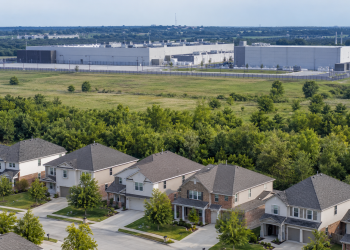
Data center lighting is one of the most overlooked reasons communities push back on new facilities. People may never hear servers, but they will notice bright perimeter lights, wall packs, and poles that change the nighttime character of an area. When lighting is poorly designed, it can create sky glow, glare, and light trespass into nearby homes.
This guide explains data center lighting in plain English: what problems communities experience, how lighting impacts are measured, what modern ordinances typically regulate, and what developers can do to reduce light pollution while still meeting security and safety requirements.
Key Takeaways
- Data center lighting usually creates complaints for three reasons: sky glow (bright night sky), light trespass (spill into nearby properties), and glare (high-angle brightness in your eyes).
- Modern best practice is purposeful, shielded, and controlled lighting rather than “bright everywhere, all night.” DarkSky summarizes this as: purpose, direction, brightness, timing, and warmer color where possible.
- Many ordinances regulate lighting using fixture shielding, uplight limits, lumen caps, and curfews for non-essential lighting.
- Photometric plans matter. The quickest way to evaluate data center lighting impacts is to request the site lighting plan and photometric map.
- Good lighting design is not anti-security. Better optics, controls, and layout often improve visibility and reduce nuisance impacts at the same time.
Why Data Center Lighting Becomes A Community Issue
Data centers typically operate 24/7, and so does their perimeter and site lighting. Over time, communities near a site may experience:
- Brighter nights from uplight and reflected light (sky glow)
- Light entering bedrooms or yards (light trespass)
- Harsh brightness at eye level from poorly aimed fixtures (glare)
- A “stadium effect” if pole lighting is overpowered or unshielded
These impacts frequently show up alongside other concerns such as traffic, noise, or generator testing. For the broader neighborhood perspective, see:
What “Light Pollution” Means In Plain English
“Light pollution” is often used as an umbrella term. A helpful practical breakdown is:
- Sky glow: the brightening of the night sky over populated areas from scattered artificial light.
- Light trespass: light spilling beyond a property line into neighboring properties.
- Glare: excessive brightness that reduces visibility and causes discomfort.
DarkSky programs and guidance emphasize directing light only where needed, limiting brightness, and using lighting only when useful. See: DarkSky Approved Luminaires Guidelines.
The U.S. Department of Energy’s SSL program also describes sky glow as a byproduct of increased light at night and notes how it manifests as a visible “light dome.” See: DOE SSL: Program Impact TM-37.
How Data Center Lighting Is Evaluated
Most jurisdictions evaluate data center lighting using a combination of plan review and measurable criteria. The two most common artifacts are:
1) Site Lighting Plan
This shows fixture locations, mounting heights, and intended coverage areas. It is the “what is installed and where” view.
2) Photometric Plan (Photometric Map)
This models light levels (often in footcandles) across the site and at the property line. If a community wants evidence-based guardrails for data center lighting, photometrics are usually the foundation.
Important: communities should request “worst-case” assumptions (all fixtures on, maximum output) plus the normal operating schedule (dimmed levels, curfew behavior, motion-based activation).
Shielding, Uplight Limits, And The BUG Rating System
One of the most practical ways to regulate data center lighting is to limit wasted light through optics and fixture performance requirements.
Full Cutoff / Fully Shielded Fixtures
“Fully shielded” generally means the fixture is designed so light does not emit upward and does not create high-angle glare. This reduces both sky glow and nuisance impacts at the property line.
BUG Ratings (Backlight, Uplight, Glare)
The lighting industry uses the BUG system to classify how a luminaire performs in three nuisance areas: backlight (trespass), uplight (sky glow), and glare (high-angle brightness). The system is defined in IES materials related to TM-15. See: IES: BUG Ratings Addendum (PDF).
Plain-English takeaway: specifying low uplight and controlled glare fixtures is one of the fastest ways to reduce complaints without reducing real security visibility.
What Modern Lighting Ordinances Typically Require
If a community wants enforceable rules for data center lighting, there are well-established ordinance models and common provisions. The IES and DarkSky jointly produced a Model Lighting Ordinance (MLO) that many local codes draw from. See: Model Lighting Ordinance (IDA + IES) (PDF).
Common ordinance tools include:
Lumen Caps (Total Light Output Limits)
Some jurisdictions cap the total lumens per acre for different land uses to prevent “over-lighting.” As an example of how this appears in real ordinances, see the lumens-per-acre limits in the Torrey, Utah ordinance: Torrey, UT Lighting Ordinance (PDF).
Uplight Restrictions
Rules often prohibit uplighting except for narrow, time-limited purposes, because uplight is a direct driver of sky glow.
Fixture Shielding Requirements
Many codes require full cutoff or fully shielded fixtures above certain lumen thresholds.
Curfews And Adaptive Controls
A “curfew” is a rule that reduces lighting levels after a set time (for example, after business hours) except for safety/security zones. Adaptive controls can include dimming, motion activation, or zoning to keep essential security coverage while lowering overall output.
Property Line Limits (Trespass Controls)
Some ordinances set maximum light levels at the property line or at nearby residences, requiring developers to demonstrate compliance in photometric plans and verify with post-construction measurements.

Developer Mitigation: How To Reduce Data Center Lighting Impacts
The best data center lighting mitigation is built into design and procurement, not added later.
Use Better Optics And Lower Mounting Heights Where Possible
- Prefer fixtures with controlled distribution and low uplight.
- Avoid overly tall poles that increase spill distance.
Design For Perimeter Security Without Over-Lighting The Entire Site
- Light critical zones (access points, gates, paths) rather than blanket-lighting parking and fence lines at full intensity.
- Use cameras and sensor strategies to reduce the need for constant maximum brightness.
Implement Controls And Curfews
- Dim non-essential areas after peak activity hours.
- Use motion-based activation for low-traffic areas.
Add Physical Mitigation When Needed
- Shielding attachments, louvers, and house-side shields can reduce spill into neighborhoods.
- Landscape berms and site walls can reduce direct line-of-sight glare.
What Communities Can Verify And Request
Communities can make data center lighting fact-based by requesting specific items during review and documenting enforceable conditions.
- Photometric plan: maximum light levels at property lines and nearest residences.
- Fixture schedule: exact fixture models, lumen output, color temperature, shielding.
- Control strategy: dimming schedules, curfews, motion zones, and failover behavior.
- Post-construction verification: measured light levels and a process for complaint-driven re-measurement.
- Expansion triggers: a requirement to re-submit lighting plans for major phase expansions.
This public-records workflow is relevant if you want a repeatable verification approach:
Frequently Asked Questions
Is data center lighting required to be “dark-sky compliant”?
Not automatically. It depends on local ordinances and permit conditions. However, many best practices align with DarkSky guidance emphasizing purposeful, directed, and time-limited lighting. See: DarkSky Approved Luminaires Guidelines.
Why does glare matter if the light levels are “within limits”?
Because glare is about high-angle brightness and visibility impacts, not only average light levels. BUG ratings explicitly include glare control for this reason. See: IES BUG Ratings Addendum (PDF).
Can a project reduce lighting and still be secure?
Yes. Security outcomes often improve with better optics, targeted coverage, and controls rather than maximum brightness everywhere. In many designs, the goal is visibility and contrast, not raw lumen output.
What is the simplest enforceable rule a community can use?
If you need a short list, start with: fully shielded fixtures, uplight limits (or BUG uplight requirements), property-line trespass limits verified by photometrics, and a curfew/dimming requirement for non-essential lighting.
Bottom Line
Data center lighting is one of the most solvable community-impact problems, but only if it is treated as an engineering and permitting topic, not a subjective debate. The best projects commit to shielded fixtures, controlled uplight, verified photometrics, and adaptive controls that reduce sky glow and trespass while maintaining real security. The best communities make it enforceable: fixture specs, property-line limits, curfews, and post-construction verification.