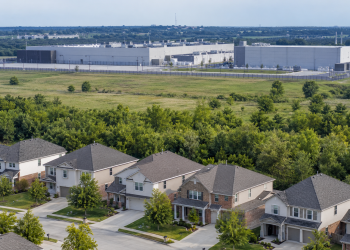
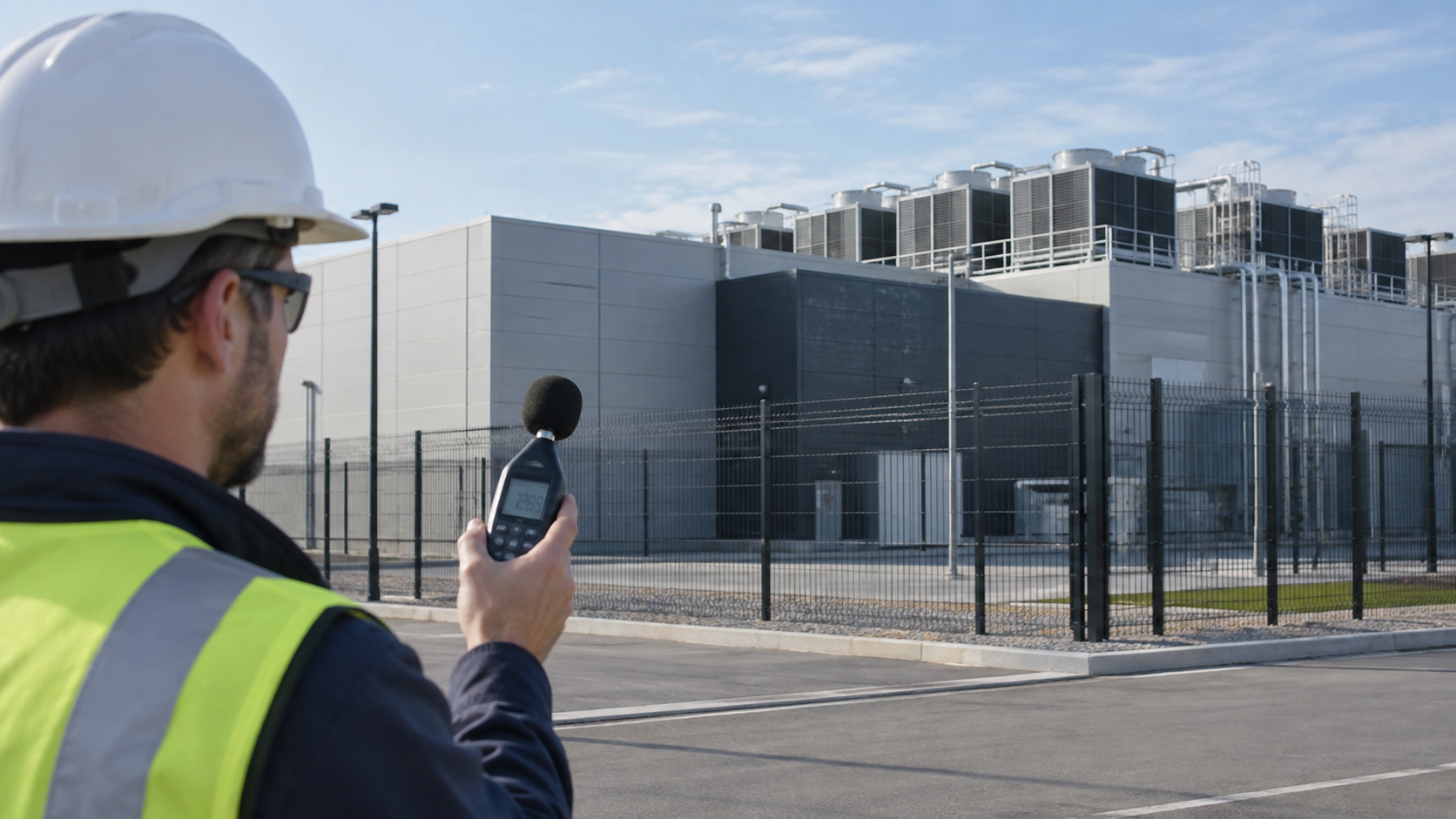
Data center noise levels can vary significantly depending on facility design, equipment, distance, barriers and surrounding conditions.
There is no single decibel number that accurately describes how loud every data center is.
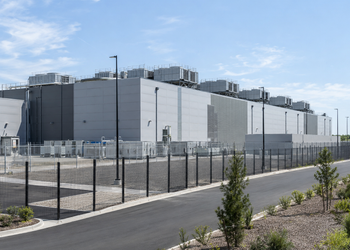
During normal operations, much of the noise reaching surrounding properties comes from exterior cooling and electrical equipment rather than the servers inside the building.
Backup generators can create much louder temporary noise when operating or undergoing routine testing.
That means the better question is not simply “How loud is a data center?”
It is:
What data center noise levels will reach the nearest homes and residential property lines?
What Creates Data Center Noise Levels?
Servers generally operate inside enclosed buildings.
Exterior mechanical and electrical equipment is often more important to surrounding neighborhoods.
Our broader data center noise explained guide examines these sources in more detail.
Cooling Equipment
Data centers consume large amounts of electricity, and much of that electricity eventually becomes heat.
That heat must be removed.
Exterior cooling infrastructure can include:
- Chillers
- Cooling towers
- Condensers
- Dry coolers
- Pumps
- Large fans
- Air-handling equipment
Some of this equipment can operate continuously.
Transformers
Large transformers can create a recognizable hum.
That sound may contain tonal or lower-frequency components that make it easier to distinguish from ordinary background noise.
Backup Generators
Data centers typically maintain backup generators to protect against utility outages.
Generators also need periodic testing.
A large campus may contain dozens of generators, making generator operation an important consideration when evaluating maximum or intermittent data center noise levels.
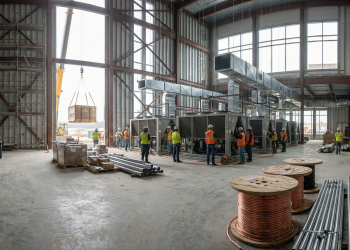
Construction
Construction creates a different noise profile entirely.
Residents may hear:
- Heavy trucks
- Excavators
- Concrete equipment
- Cranes
- Pile driving
- Temporary generators
Construction noise should therefore be evaluated separately from long-term operational data center noise levels.
Why Data Center Noise Levels Cannot Be Reduced to One Number
Statements such as “a data center produces 60 dBA” are incomplete.
Sound changes with distance.
Equipment models differ.
Buildings can block sound.
Acoustic barriers and berms can reduce propagation.
Terrain and weather can affect how sound travels.
The most useful data center noise levels are therefore usually measured or predicted at a specific receptor, such as:
- A residential property line
- A nearby home
- A school
- Another sensitive location
Understanding Data Center Noise Levels in Decibels
The decibel scale is logarithmic rather than linear.
OSHA’s explanation of the decibel scale explains that relatively small numerical changes can represent substantial changes in sound pressure.
General reference examples include:
| Sound Level | Approximate Reference |
|---|---|
| 20 dBA | Very quiet room |
| 40 dBA | Quiet indoor environment |
| 50 dBA | Moderate residential background |
| 60 dBA | Normal conversation |
| 70 dBA | Busy indoor environment |
| 80 dBA | Loud environment or equipment |
These values are only general comparisons.
They should not be treated as typical data center noise levels.
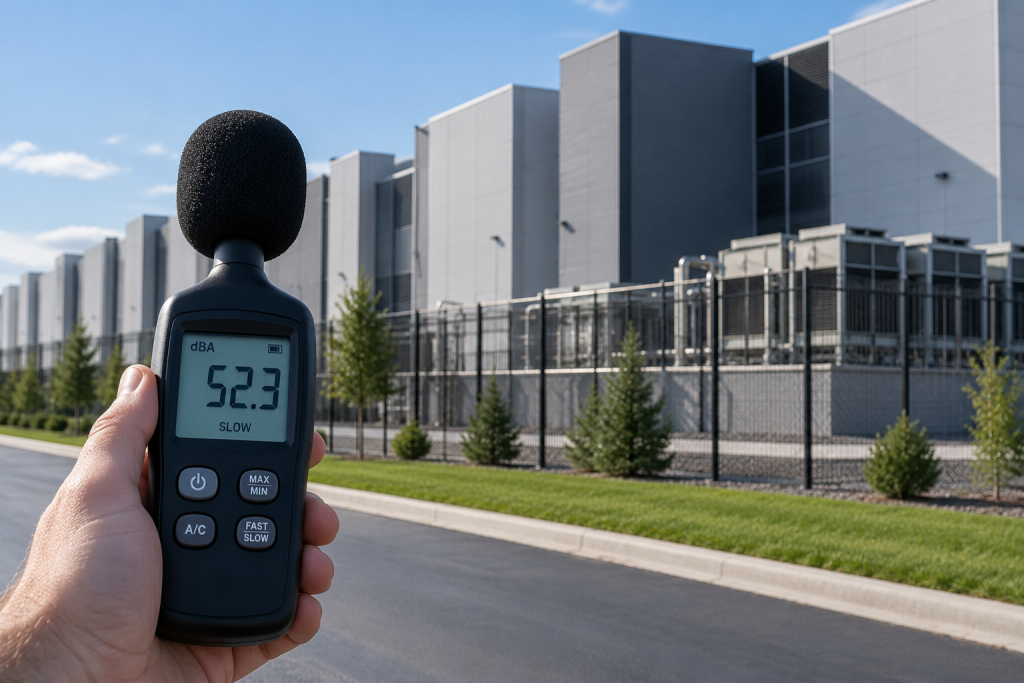
What Does dBA Mean for Data Center Noise Levels?
Sound studies commonly report dBA, or A-weighted decibels.
A-weighting adjusts the measurement to approximate human hearing sensitivity.
Other measurements can include:
Leq
Equivalent continuous sound level over a specified period.
This can be useful for evaluating continuous cooling and mechanical equipment.
Lmax
Maximum recorded sound level.
This can be useful for evaluating intermittent events such as generator operation.
Ldn
Day-night average sound level.
This gives additional weighting to nighttime sound because nighttime noise can be more disruptive.
These measurements answer different questions.
A single dBA figure therefore rarely provides a complete picture.
Are There Legal Data Center Noise Levels?
There is no single nationwide noise limit specifically for data centers.
Local ordinances are much more important.
Loudoun County, Virginia, for example, requires data centers to submit both pre-construction and post-construction noise studies.
Its zoning rules establish a maximum sound level of 55 dBA at the receiving property line for residential properties, according to the county’s official data center noise and air-quality guidance.
That does not mean 55 dBA is a national data center noise standard.
Other jurisdictions can use different limits, measurement periods and enforcement methods.
Why Lower Data Center Noise Levels Can Still Be Noticeable
The headline decibel number does not fully describe how people perceive noise.
Background Noise
A certain sound level may blend into a busy commercial environment.
The exact same sound can be much more noticeable in a quiet rural setting.
Tonal Noise
A persistent hum can attract attention even when the total measured data center noise level is relatively low.
Nighttime Conditions
Traffic and neighborhood activity often decline at night.
Cooling or electrical equipment may therefore become easier to hear even if it is operating at the same level.
Duration
Continuous sound can be more noticeable than a short event at the same dBA.
Frequency
Low-frequency sound can sometimes be perceived as:
- Humming
- Throbbing
- Vibration
These characteristics can matter even when a facility technically complies with the applicable noise limit.
How Can Data Center Noise Levels Be Reduced?
Noise mitigation is generally easier before a data center is constructed.
Increase Setbacks
Greater distance between equipment and homes generally reduces sound.
Move Equipment Away From Homes
Cooling systems, generators and transformers can be positioned on sides of the property facing away from residential neighborhoods.
Use the Building as a Sound Barrier
The main data center building can sometimes be placed between noisy equipment and homes.
Install Acoustic Barriers
Mitigation can include:
- Acoustic walls
- Berms
- Equipment enclosures
- Sound screens
Specify Quieter Equipment
Developers can include noise-performance requirements when purchasing fans, chillers and generators.
Restrict Generator Testing
Where local regulations allow, generator tests can be scheduled during daytime hours.
What Should a Data Center Noise Study Include?
A useful study should evaluate:
- Existing background noise
- Daytime conditions
- Nighttime conditions
- Nearest homes
- Residential property lines
- Cooling equipment
- Transformers
- Generator testing
- Full campus build-out
- Future phases
- Acoustic barriers
- Post-construction testing
A study analyzing only Phase 1 can underestimate future data center noise levels if the campus later expands.
Our data center town hall questions guide includes additional questions residents can ask about acoustic studies and mitigation.
Can You Hear Data Center Noise From Your House?
Possibly.
Whether a facility is audible depends on:
- Distance
- Cooling technology
- Generator placement
- Transformer placement
- Acoustic barriers
- Terrain
- Existing background noise
- Facility orientation
- Weather
A well-designed facility may be difficult to distinguish from ambient sound.
A poorly designed or insufficiently buffered site can produce much more noticeable data center noise levels.
Why Data Center Noise Levels Create Community Concerns
Noise is one of the most direct ways residents can experience data center development.
Unlike tax revenue or electricity demand, noise can potentially affect people while they are inside their homes.
That is one reason noise frequently appears in debates involving community opposition to data centers.
Strong noise requirements rely on measurable standards rather than vague promises that a facility will be “quiet.”
Frequently Asked Questions About Data Center Noise Levels
What are typical data center noise levels?
There is no universal figure. Data center noise levels depend on equipment, facility design, distance and surrounding conditions.
How loud is a data center?
The noise reaching surrounding homes depends primarily on cooling systems, transformers, generators and the distance between those sources and the residence.
What causes data center humming?
Transformers, fans, pumps and other equipment can create tonal or lower-frequency sound perceived as humming.
Are data center noise levels higher at night?
Not necessarily. However, lower nighttime background noise can make the facility easier to hear.
Is 55 dBA the national data center noise limit?
No. Loudoun County uses a 55 dBA residential receiving-property limit, but local ordinances vary.
Bottom Line: Data Center Noise Levels Depend on the Site
Data center noise levels cannot be reduced to one universal decibel number.
The amount of sound reaching surrounding neighborhoods depends on:
- Equipment
- Distance
- Barriers
- Site design
- Background noise
- Operating conditions
For residents and public officials, the most useful information is a site-specific analysis showing expected data center noise levels during normal operations, nighttime conditions, generator testing and full campus build-out.