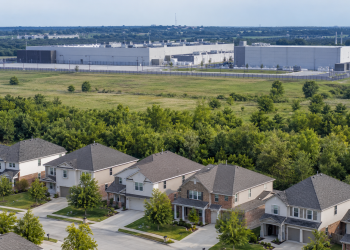
Data center property values is one of the most emotionally charged topics in community meetings. Homeowners want a clear answer: “Will this lower my home’s value?” Developers often respond with broad claims: “It won’t have any impact.” The honest answer is more nuanced. The direction and magnitude of impact depends on what people experience day to day and how the local market perceives the project.
This guide explains data center property values in plain English: what research on nearby industrial development and nuisance factors tends to show, what drives outcomes near a specific project, and what residents and local officials can do to evaluate risk and push for enforceable mitigations.
Key Takeaways
- Data center property values are mostly influenced by lived impacts: noise, lighting, traffic, visual screening, and perceived future expansion risk.
- There is no universal answer. Real estate impacts depend on the baseline neighborhood, distance, and how well the project is buffered and managed.
- Data centers can be low-traffic and visually controlled compared to other industrial uses, but community opposition often arises when nuisance factors are not mitigated.
- Local governments can reduce risk through enforceable conditions: setbacks, landscaping, lighting controls, noise limits, truck routing, and expansion triggers.
- The most credible way to evaluate data center property values is to measure and document the actual nuisance factors that affect buyer perception.
What “Property Value Impact” Actually Means
When people talk about data center property values, they often mean one of three things:
- Sale price impact: do homes sell for less than they would have without the project?
- Time on market impact: do homes take longer to sell due to buyer hesitation?
- Stigma / perception impact: do buyers discount the neighborhood because they fear noise, growth, or future industrial creep?
Appraisers often capture these effects indirectly through comparable sales, market conditions, and adjustments. For a community, the practical question is: what about this project changes buyer experience?
What Research Typically Looks At: Externalities And Hedonic Pricing
Most rigorous property value studies use “hedonic pricing” approaches. In simplified terms, hedonic models estimate how different features (bedrooms, school quality, proximity to amenities, proximity to nuisances) correlate with sale prices.
The U.S. EPA describes how hedonic pricing is used to estimate economic values for environmental quality changes, including impacts from noise and other disamenities. EPA: Hedonic Pricing (Environmental Economics).
The Federal Highway Administration (FHWA) discusses how transportation-related noise and infrastructure changes can affect community and economic outcomes, and how analysis frameworks consider property impacts. FHWA: Traffic Noise.
Important limitation: Even strong research tends to generalize across places. Your local outcome depends on local factors. That is why a “research says X” claim is less useful than a “here is what drives X” framework you can apply to your project.
What Drives Data Center Property Values In The Real World
Most of the time, data center property values are affected through a handful of mechanisms. If these are minimized, the risk is lower. If they are uncontrolled, the risk is higher.
1) Visibility And Visual Character
A data center can be visually unobtrusive or feel like a fortress. Tall blank walls, bright security lighting, and large substations can change neighborhood character. Screening, landscaping, and architectural design can reduce this effect.
2) Noise (Especially At Night)
Noise complaints can create stigma quickly. Persistent tonal hum, rooftop fan noise, or generator testing can influence buyer willingness. Your earlier content connects here:
3) Lighting And Nighttime Impacts
Bright perimeter lighting can change the feel of a neighborhood. Sky glow and light trespass are particularly noticeable and often remembered by buyers during showings. Related internal guide:
4) Traffic And Construction Disruption
Construction impacts can be intense. Even if operations are low-traffic, the construction period can influence neighborhood reputation and buyer psychology. Related internal guide:
5) Expansion Risk And Uncertainty
Buyers discount uncertainty. Even if Phase 1 is quiet, buyers worry about Phase 2, Phase 3, and new substations. That uncertainty can influence data center property values more than the current facility’s actual impacts.
6) Local Market Strength And Baseline Land Use
In markets with strong demand and limited supply, small disamenities may have limited price impact. In weaker markets, nuisance impacts can matter more. Also, if an area is already industrial-adjacent, a data center may be perceived differently than if it is placed next to established residential neighborhoods.
How To Evaluate A Proposed Data Center Near You
If you want to evaluate data center property values risk in a way that is defensible and actionable, focus on measurable nuisance factors and enforceable conditions.
Step 1: Map Distance And Line Of Sight
- Which homes have direct line-of-sight to the facility?
- What are the distances to property lines and major equipment yards?
- What screening exists or is proposed?
Step 2: Identify The Likely Nuisance Drivers
- Cooling equipment locations and heights
- Generator locations and testing schedule
- Lighting layout, shielding, and curfews
- Truck routes and construction access points
Step 3: Convert Concerns Into Permit Conditions
Concerns reduce property value risk only when they become enforceable. Useful conditions include:
- Noise limits at property lines, with post-construction verification and tonal penalties where applicable
- Lighting standards (fully shielded fixtures, photometric property-line limits, curfews)
- Construction haul routes and limits on heavy hauling hours
- Landscape and screening requirements (berms, evergreen buffers, wall treatments)
- Expansion triggers requiring re-review if additional buildings or equipment are added
Step 4: Use Public Records To Verify Commitments
Many of the strongest facts about a project can be verified through permits, site plans, and inspection records. Your internal process guide is the right companion:
What Developers Can Do To Reduce Property Value Risk
Developers who want smoother approvals and lower conflict should treat data center property values as an outcome of design choices, not a debate topic.
- Design equipment yards away from homes and add physical screening.
- Commit to lighting controls and publish the operating plan.
- Restrict generator testing windows and use attenuation where needed.
- Fund intersection and access improvements when construction traffic is intense.
- Be transparent about phasing so expansion is not treated as a surprise.

Frequently Asked Questions
Do data centers always lower property values?
No. Data center property values outcomes vary. Impacts depend on distance, screening, nighttime noise and lighting, construction disruption, and market conditions. The most useful approach is to evaluate these drivers locally and make mitigation enforceable.
Is there any reliable way to “prove” future impacts?
You can reduce uncertainty by requiring measurable standards (noise, lighting, traffic) and post-construction verification. That does not eliminate all uncertainty, but it makes the project accountable in ways that buyers and residents can understand.
What matters more: being close to a data center, or being able to see it?
Both matter, but visibility can drive perception quickly. Many nuisance impacts (glare, visual character) are line-of-sight issues. That is why screening and setbacks are meaningful levers for data center property values.
Where can communities find objective valuation frameworks?
Hedonic pricing is one common framework used in environmental and policy analysis. EPA’s overview is a good starting point: EPA: Hedonic Pricing.
Bottom Line
Data center property values are not determined by a single label like “data center.” They are determined by what people experience: noise, lighting, traffic, visibility, and uncertainty about expansion. Communities reduce risk when they translate concerns into enforceable standards and verification. Developers reduce conflict when they design for quiet, dark, screened operations and publish a transparent plan for how the facility will behave over time.