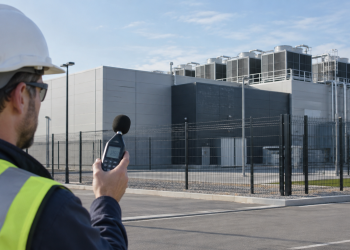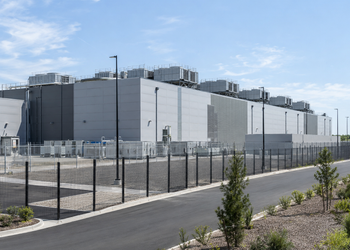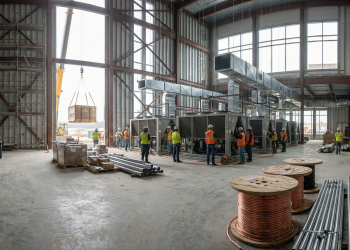
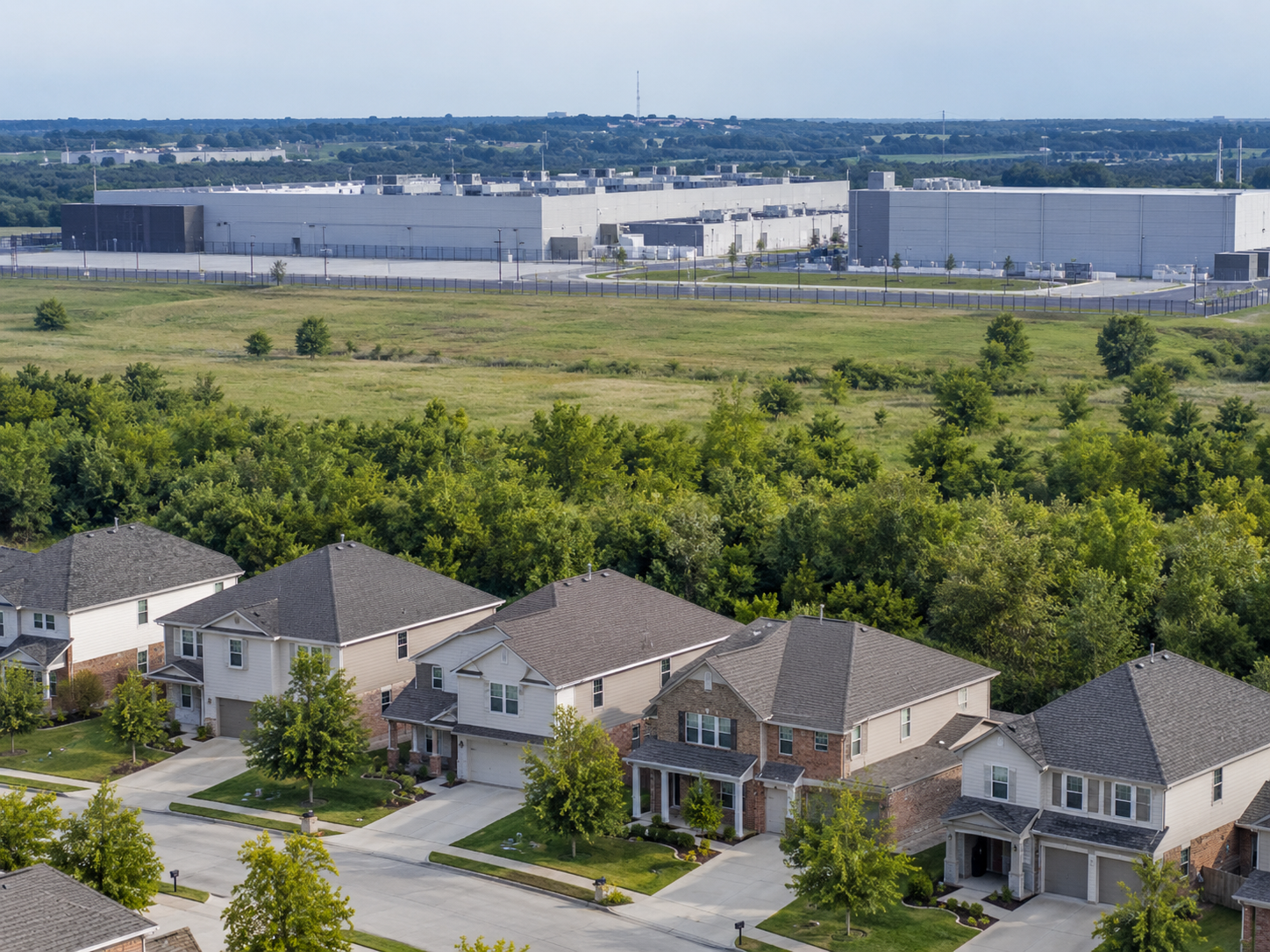
A data center setback determines how much physical separation must exist between a data center building or its equipment and another property, structure or land use.
For residents living near a proposed development, that leads to an obvious question:
How close can a data center be to homes?
There is no single nationwide answer.
Data center setback requirements are generally established through local zoning ordinances, development approvals and site-specific conditions.
One community may require several hundred feet of separation.
Another may require significantly more.
Different data center setback requirements can even apply to the main building, generators, cooling systems and other equipment on the same property.
What Is a Data Center Setback?
A data center setback is the minimum required distance between part of a data center development and another defined location.
The measurement may begin or end at:
- A property line
- A residential zoning district
- An existing home
- A roadway
- A school
- Another sensitive land use
The reference point matters.
For example:
200 feet from a residential property line
does not mean:
200 feet from the nearest house.
If the house sits another 150 feet inside the residential parcel, the actual distance between buildings would be larger.
Residents should therefore determine exactly how the local ordinance defines the data center setback.
Is There a Federal Data Center Setback Requirement?
There is no general federal zoning requirement establishing one minimum data center setback for every project in the United States.
Local governments typically regulate data center development through:
- Zoning districts
- Special-use permits
- Conditional-use permits
- Setbacks
- Landscape buffers
- Noise limits
- Lighting requirements
- Development agreements
The local zoning ordinance is therefore one of the first documents residents should review.
If you’re still trying to determine whether a project has even been proposed, our guide explaining how to find out if a data center is planned near you explains how to search local zoning and planning records.
Fairfax County Data Center Setback Requirements
Fairfax County, Virginia provides a useful real-world example.
Under its current zoning requirements, data center buildings must generally be at least 200 feet from the lot line of an adjacent or abutting residential district or residential property.
The county also generally requires certain ground-mounted equipment, including backup generators, to be 300 feet from residential property, unless the data center building itself separates the equipment from that property.
You can review the details in Fairfax County’s data center zoning amendment summary.
Those figures illustrate how a local data center setback can work.
They are not national standards.
Another city or county may use very different requirements.
Why a Data Center Setback Applies to More Than the Main Building
A data center campus contains much more than its primary building.
Residents should look for the location of:
- Cooling equipment
- Backup generators
- Transformers
- Substations
- Electrical yards
- Fuel storage
- Loading docks
- Internal roads
- Security lighting
A building may satisfy its data center setback while mechanical equipment sits closer to surrounding property.
Conversely, good site design can use the building itself as an acoustic barrier between equipment and nearby homes.
That is why residents should examine the entire site plan rather than one setback measurement.
Why Data Center Setback Requirements Matter
Distance can reduce several potential community impacts.
Noise
Cooling equipment, transformers and generators can create sound.
Greater separation generally helps reduce the amount of noise reaching homes.
Our guide to data center noise levels explains how equipment, barriers and distance affect neighborhood sound.
You can also read our broader data center noise explainer.
Visual Impact
Data center buildings can be extremely large.
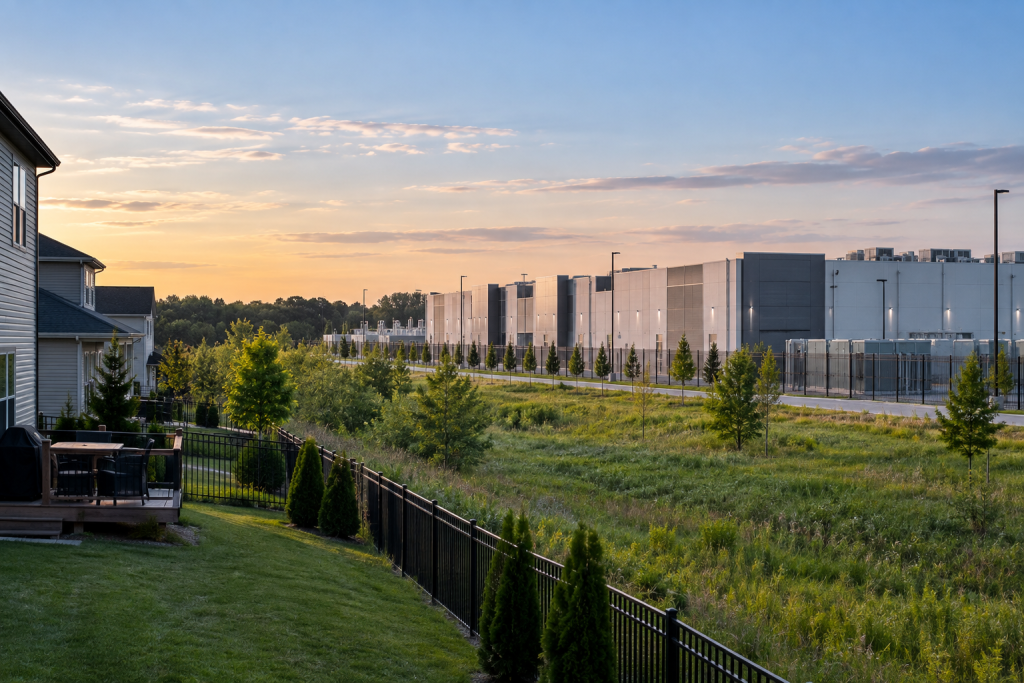
A larger data center setback provides more space for:
- Trees
- Berms
- Fencing
- Landscape buffers
- Architectural screening
Generator Operations
Backup generators can create temporary noise and exhaust.
Increasing the distance between generator yards and nearby homes can reduce those impacts.
Lighting
Security and operational lighting can affect surrounding residential properties when fixtures are poorly positioned.
Distance, vegetation and shielding can help.
Traffic
The largest traffic impacts often occur during construction.
Our guide to data center traffic impacts explains how construction traffic differs from normal operations.
What Is a Good Data Center Setback?
There is no universally correct distance.
The appropriate data center setback depends on:
- Facility size
- Generator count
- Cooling technology
- Equipment location
- Site orientation
- Existing background noise
- Terrain
- Acoustic barriers
- Landscaping
- Nearby land uses
- Local noise requirements
A 500-foot data center setback at one site can produce very different results from a 500-foot setback somewhere else.
This is why distance alone should not be the only development standard.
Data Center Setback vs. Noise Limit
A data center setback controls distance.
A noise limit controls sound.
They are related, but they are not the same thing.
A large setback does not guarantee residents will never hear the facility.
Likewise, a smaller setback does not automatically mean the facility will violate a local noise ordinance.
Loudoun County provides an example of combining land-use requirements with performance standards. Its data center noise requirements include pre-construction and post-construction sound studies and maximum noise levels at receiving property lines.
A stronger regulatory framework can therefore combine:
- Minimum data center setback
- Maximum allowable sound
- Pre-construction modeling
- Post-construction verification
- Required corrective action
What If the Data Center Is Allowed By Right?
This distinction can significantly change what residents can influence.
Some zoning districts allow data centers by right.
A by-right project may not need the same discretionary public approval process as a rezoning or special-use permit, provided it complies with existing rules.
Other jurisdictions require additional approval.
Loudoun County, for example, says it eliminated by-right data center development in 2025 and now requires future projects to go through a special-exception process.
Residents should determine:
- What is the current zoning?
- Are data centers permitted?
- Is rezoning required?
- Is a special-use permit required?
- What data center setback applies?
- Is the developer requesting a variance or exception?
What Should Residents Measure on a Site Plan?
Do not rely only on renderings.
Request a scaled site plan.
Measure or ask for the distance between residential property and:
- Main data center buildings
- Generator yards
- Cooling equipment
- Transformers
- Substations
- Loading areas
- Access roads
- Parking
- Landscape buffers
Also determine whether the site plan represents:
Phase 1 only
or
the full campus at build-out.
A project may eventually contain several large buildings even if only the first phase is emphasized during early public discussions.
Questions to Ask About a Data Center Setback
If a data center is proposed near homes, ask:
- What is the legally required data center setback?
- What setback is actually proposed?
- How far is the nearest existing house?
- Where will generators be located?
- Where will cooling equipment be located?
- Where will transformers be located?
- Will a substation be built?
- What nighttime noise limit applies?
- Has an acoustic study been completed?
- Does the study model full build-out?
- What landscaping is required?
- Are berms proposed?
- Can the data center setback later be reduced?
- What happens if post-construction noise exceeds predictions?
Our data center town hall questions guide includes additional questions covering electricity, water, taxes, traffic and community impacts.
Why Data Center Setback Rules Are Becoming More Important
Data center development is increasingly expanding outside long-established industrial markets.
Developers often search for locations with:
- Large parcels
- Transmission access
- Utility capacity
- Fiber
- Favorable zoning
- Economic incentives
That can bring large projects closer to suburban, exurban and rural neighborhoods.
Those siting conflicts are one reason community opposition to data centers has become more prominent.
For residents, the debate is often less about data centers as a technology and more about basic land-use compatibility:
Is this industrial-scale facility adequately separated from surrounding homes?
Frequently Asked Questions About Data Center Setback Requirements
What is a data center setback?
A data center setback is the minimum required distance between a data center building or equipment and another property, zoning district or land use.
How close can a data center be to homes?
There is no nationwide minimum. The applicable data center setback is generally determined by local zoning.
Is 200 feet a standard data center setback?
No. Fairfax County uses a 200-foot residential setback for certain data center buildings, but that does not make 200 feet a national standard.
Can generators have a larger data center setback?
Yes. Some jurisdictions establish separate or larger setbacks for backup generators and other exterior mechanical equipment.
Does a larger data center setback eliminate noise?
No. Greater distance generally helps, but equipment design, barriers, terrain and operating conditions also affect noise.
Can residents influence data center setback requirements?
Potentially. Residents usually have more influence during zoning amendments, rezonings and discretionary permit reviews than after final project approvals.
Bottom Line: A Data Center Setback Is a Local Zoning Decision
A data center setback is one of the most important land-use tools for separating industrial-scale data center infrastructure from nearby homes.
There is no single national distance.
Local zoning determines the applicable data center setback, and residents should look beyond the main building to identify where generators, cooling systems, transformers, substations and future phases will be located.
The strongest approach combines an appropriate data center setback with measurable standards for noise, lighting, landscaping and post-construction compliance.