Data center substation design determines how electricity moves from the utility grid into a data center campus.
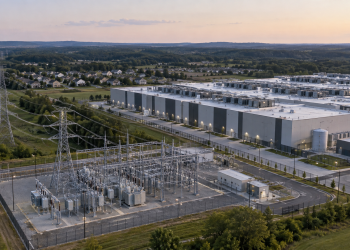
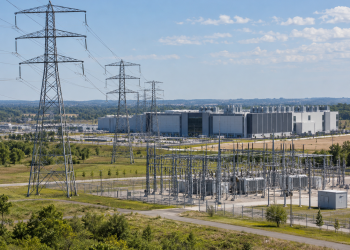
From the outside, a data center substation can look like a fenced yard filled with transformers, steel structures, electrical conductors and circuit breakers.
But each component has a specific purpose.
The exact design depends on:
- Facility power demand
- Utility voltage
- Reliability requirements
- Available land
- Number of buildings
- Planned future expansion
For large hyperscale campuses, a substation may occupy significant land and support hundreds of megawatts of electrical capacity.
What Does Data Center Substation Design Include?
A typical data center substation design can include:
- Power transformers
- Circuit breakers
- Busbars
- Disconnect switches
- Insulators
- Protective relays
- Instrument transformers
- Control building
- Utility metering
- Transmission connections
- Distribution feeders
- Security fencing
The U.S. Energy Information Administration explains that transformers at substations increase or reduce voltage as electricity moves between power plants, transmission lines and end users.
For a complete explanation of the substation’s function, read our main guide: Data Center Substation: What It Is, How It Works & Why It Matters.
This article focuses specifically on data center substation design, layout and appearance.
A Simple Data Center Substation Layout
A simplified power path might look like:
Transmission line
↓
High-voltage switching equipment
↓
Power transformer
↓
Medium-voltage switchgear or bus
↓
Campus feeders
↓
Data center building electrical system
↓
UPS and power distribution
↓
Servers
Actual data center substation layouts can be significantly more complicated because facilities often require redundant paths.
Power Transformers
Transformers are usually among the largest components visible inside a substation.
Their job is to change voltage.
High-voltage transmission electricity cannot be delivered directly to ordinary data center equipment.
A power transformer steps the voltage down to a level that can be distributed throughout the campus.
The EIA’s transformer explanation provides a useful overview of why transformers are necessary for moving electricity efficiently.
Large data center substations can contain multiple transformers.
Why Data Center Substation Design Often Uses Multiple Transformers
Multiple transformers can provide:
- Greater capacity
- Redundancy
- Maintenance flexibility
- Expansion capacity
- Separate service for different buildings
Imagine a campus designed for 200 MW.
The developer may not want one transformer to become a single point of failure.
Instead, the substation can divide capacity among several transformers and electrical paths.
The exact redundancy architecture varies by utility and data center operator.
Circuit Breakers
High-voltage circuit breakers protect the electrical system.
If a fault occurs, breakers can interrupt current and isolate the affected equipment.
They serve a similar basic purpose to breakers in a home electrical panel—but at dramatically larger voltage and power levels.
A data center substation can contain multiple breakers associated with:
- Incoming transmission lines
- Transformers
- Bus sections
- Outgoing feeders
Busbars and Electrical Buses
A bus is a common electrical connection point.
In substations, large conductors distribute electricity among:
- Transformers
- Breakers
- Transmission circuits
- Feeders
Different bus configurations provide different levels of:
- Reliability
- Flexibility
- Cost
- Complexity
Large data centers often value configurations that allow maintenance or equipment failures without interrupting the entire campus.
Disconnect Switches
Disconnect switches physically isolate equipment.
They are important during:
- Maintenance
- Repairs
- Emergencies
Unlike a circuit breaker, a disconnect is generally used to create a visible isolation point rather than automatically interrupt large fault currents.
Protective Relays
Protective relays monitor electrical conditions.
They can detect:
- Short circuits
- Abnormal voltage
- Excess current
- Equipment faults
When the relay detects a dangerous condition, it can instruct the appropriate circuit breaker to open.
These systems are essential because electrical faults at transmission-level voltages can be extremely damaging.
Control Building
Many data center substation designs include a small control building inside or beside the electrical yard.
The building can contain:
- Protection equipment
- Communications
- Monitoring systems
- Batteries
- Control electronics
- SCADA equipment
The control building allows utilities and operators to monitor and control the substation.

What Does a Data Center Substation Look Like From the Outside?
Common visible features include:
- Security fencing
- Large gray transformers
- Tall steel structures
- Porcelain or composite insulators
- Electrical conductors
- Circuit breakers
- Utility poles
- Transmission towers
- Gravel-covered ground
- Control buildings
Vegetation is generally limited inside the energized equipment area.
Substations typically use gravel surfaces because the design must account for:
- Drainage
- Equipment access
- Grounding
- Vegetation control
How Big Is a Data Center Substation?
There is no universal size.
The footprint depends on:
- Voltage
- Transformer count
- Capacity
- Bus configuration
- Required clearances
- Utility standards
- Future expansion
A small distribution substation can be relatively compact.
A transmission-level substation serving a massive data center campus can occupy many acres.
The important point is that the substation itself can become a meaningful part of the total data center land footprint.
Where Is the Substation Located on a Data Center Campus?
Possible locations include:
- Directly beside the data center
- At the edge of the campus
- On a separate utility parcel
- Near an existing transmission corridor
Developers may intentionally locate the substation near existing transmission infrastructure to reduce the length of new high-voltage connections.
But location also affects:
- Visual impact
- Noise
- Residential setbacks
- Utility easements
How Transmission Lines Connect to a Data Center Substation
Large campuses may receive electricity directly from high-voltage transmission infrastructure.
The transmission line enters the substation, where:
- Switching equipment controls the connection.
- Transformers reduce voltage.
- Electricity enters the campus distribution system.
Some projects require new transmission infrastructure.
Our guide to data center transmission lines explains when and why this happens.
Why Data Center Substation Design Prioritizes Reliability
Data centers are mission-critical facilities.
A power failure can affect:
- Cloud services
- AI workloads
- Business systems
- Communications
- Online services
Data center electrical architecture therefore typically includes several layers of redundancy.
Those can include:
- Multiple utility feeds
- Multiple transformers
- Separate bus sections
- UPS systems
- Batteries
- Backup generators
The substation is only one part of that overall resilience strategy.
How Substation Design Changes for a Multi-Building Campus
A hyperscale campus may eventually contain multiple large buildings.
The electrical system can grow in phases.
For example:
Phase 1
- Initial substation
- Two transformers
- First data center building
Phase 2
- Additional transformer
- Additional feeder
- Second building
Phase 3
- Second substation
- Additional transmission connection
- More buildings
This is why site plans should be reviewed at full build-out, not only Phase 1.
What Is an N-1 Substation Design?
Utilities commonly plan systems around contingencies.
An N-1 concept means the system is designed to withstand the loss of one important component without causing unacceptable service failure.
For example, planners may examine what happens if:
- One transformer fails
- One transmission line is unavailable
- One breaker is out of service
The specific reliability standard depends on the utility and system.
But the principle explains why usable capacity can be lower than simply adding together equipment nameplate ratings.
Why Transformers Affect Data Center Substation Design
Large transformers are difficult equipment to manufacture, transport and replace.
They also need:
- Physical separation
- Fire protection considerations
- Oil containment
- Maintenance access
Transformer procurement has become an important constraint for large data center developments.
See our guide to the data center substation and transformer bottleneck for more detail.
Does a Data Center Substation Make Noise?
Yes.
Transformers can create a steady electrical hum.
Other equipment may also produce intermittent mechanical or electrical sound.
Whether the substation is noticeable from nearby homes depends on:
- Distance
- Transformer design
- Barriers
- Terrain
- Existing background sound
Our guide to data center noise levels explains how these factors affect surrounding properties.
Questions to Ask When Reviewing a Data Center Substation Design
Ask:
- What is the substation voltage?
- What is the planned capacity in MW?
- How many transformers?
- How large is the substation footprint?
- Is future expansion shown?
- Where do transmission lines enter?
- Is a second substation planned?
- Who owns the substation?
- How close is it to homes?
- What noise analysis was completed?
- What visual screening is provided?
Frequently Asked Questions About Data Center Substation Design
What does a data center substation look like?
It typically resembles a high-voltage utility substation with transformers, steel structures, breakers, conductors, busbars, fencing and a control building.
What is included in data center substation design?
The design can include transformers, circuit breakers, bus systems, disconnect switches, protective relays, controls and incoming and outgoing electrical connections.
How big is a data center substation?
Size varies widely. Large transmission-level substations serving hyperscale campuses can occupy substantial acreage.
Why do large data centers need multiple transformers?
Multiple transformers provide additional capacity, flexibility and redundancy.
Can a data center have multiple substations?
Yes. Very large campuses may use several substations as capacity grows.
Bottom Line: Data Center Substation Design Connects the Campus to the Grid
Data center substation design determines how massive amounts of grid electricity are transformed, protected and delivered into the data center campus.
From the outside, the substation may look like a collection of transformers and steel electrical equipment.
In reality, its layout determines:
- Capacity
- Reliability
- Expandability
- Grid connectivity
For today’s largest AI and hyperscale projects, understanding the data center substation design can reveal almost as much about the project’s scale as the data center buildings themselves.