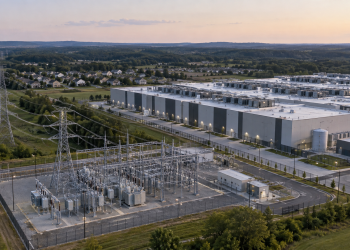
A data center substation is one of the most important pieces of infrastructure required to power a modern data center.
It connects a large data center load to the electric grid, transforms electricity to usable voltage levels and provides the switching, protection and control equipment needed to deliver power safely and reliably.
For large hyperscale and AI campuses, the data center substation can also determine whether the project can actually receive the hundreds of megawatts of electricity it expects to use.
That is why a proposed data center can have land, zoning approval and even nearby transmission lines but still face years of delay waiting for electrical infrastructure.
What Is a Data Center Substation?
A data center substation is an electrical substation designed to serve all or part of a data center’s electricity demand.
The U.S. Energy Information Administration explains that substations and transformers are fundamental parts of the electric grid. High-voltage transmission lines carry electricity over long distances, while transformers at substations raise or lower voltage as electricity moves between different parts of the grid.
For a data center, that process can look roughly like this:
Power generation → transmission lines → data center substation → campus electrical distribution → building transformers → UPS systems → servers
The exact architecture depends on the size of the facility and the utility serving it.
For the broader electrical picture, see our guide to data centers and the power grid.
What Does a Data Center Substation Actually Do?
A data center substation performs several critical functions.
1. Changes Electricity Voltage
Electricity is transmitted over long distances at high voltage because that is more efficient.
But servers do not operate directly on high-voltage transmission electricity.
Transformers inside or associated with the data center substation reduce voltage to levels that can be distributed throughout the campus.
Voltage may be stepped down multiple times before electricity reaches the servers.
2. Protects the Electrical System
Substations contain equipment designed to detect and isolate electrical faults.
That can include:
- Circuit breakers
- Protective relays
- Disconnect switches
- Instrument transformers
- Monitoring equipment
If a fault occurs, these systems can isolate the affected portion of the electrical network rather than allowing the problem to spread.
3. Controls Power Flow
Utilities need to know how much electricity a major customer is consuming and must be able to safely operate the connection.
A data center substation therefore contains instrumentation, communications and control systems that provide visibility into the electrical load.
4. Creates a Connection Point to the Grid
For very large data centers, the substation can effectively become the point where regional grid infrastructure meets the campus.
That is why substation capacity is so closely tied to whether a project actually has usable power.
What Equipment Is Inside a Data Center Substation?
A typical data center substation can contain several major components.
Power Transformers
Transformers change the voltage of electricity.
They are often among the largest and most visually obvious pieces of equipment in a substation.
Large power transformers have also become a significant supply-chain concern for utilities and data center developers.
Our guide to the data center substation and transformer bottleneck explains why transformer availability can affect project schedules.
Circuit Breakers
High-voltage circuit breakers can interrupt electrical current when a fault occurs.
They are an essential part of protecting the substation, transmission system and downstream equipment.
Busbars
Busbars are large conductive structures that distribute electricity between circuits inside the substation.
They allow multiple transformers, transmission lines or feeders to connect within the same electrical yard.
Disconnect Switches
Disconnect switches allow equipment to be isolated for maintenance or emergencies.
Protective Relays
Relays monitor electrical conditions and can instruct breakers to open when abnormal conditions occur.
Control Building
Many substations contain a control building housing:
- Protection systems
- Communications
- Monitoring equipment
- Batteries
- Control electronics
Transmission or Distribution Connections
Depending on the project, the substation may connect directly to:
- High-voltage transmission lines
- Sub-transmission infrastructure
- High-capacity distribution circuits
How a Data Center Substation Fits Into the Power Grid
Understanding the difference between transmission and distribution helps explain where a data center substation fits.
Transmission
Transmission lines move large quantities of electricity over long distances at high voltage.
Very large data centers may require transmission-level service because their electricity demand exceeds what ordinary distribution infrastructure can provide.
Our guide to data center transmission lines explains why these projects can require new transmission infrastructure.
Distribution
Distribution networks deliver lower-voltage electricity to ordinary homes and businesses.
Some smaller data centers can connect through distribution infrastructure.
Larger facilities may require dedicated feeders, dedicated substations or direct transmission connections.
The distinction largely depends on:
- Facility MW demand
- Existing utility capacity
- Voltage available nearby
- Reliability requirements
- Utility design
How Much Power Can a Data Center Substation Handle?
There is no standard MW capacity for every data center substation.
Capacity depends on:
- Transformer size
- Number of transformers
- Voltage
- Bus configuration
- Utility infrastructure
- Redundancy requirements
- Upstream transmission capacity
For example, installing multiple large transformers could theoretically provide hundreds of megawatts of transformation capacity.
But transformer nameplate capacity alone does not mean that amount of power is actually available.
The upstream transmission network must also be able to deliver it reliably.
This is one reason the phrase “there is a substation nearby” does not necessarily mean a proposed data center can connect immediately.
Our guide explaining how much power a data center uses puts these MW requirements into context.

Does Every Data Center Need Its Own Substation?
No.
Smaller facilities may receive electricity from existing utility substations.
A dedicated data center substation becomes more common as electrical demand increases.
A major hyperscale campus may have:
- One dedicated substation
- Multiple substations
- Multiple utility feeds
- Multiple transformer banks
- Separate electrical infrastructure for different phases
A campus can also expand its substation infrastructure as additional buildings are constructed.
What Does a Data Center Substation Look Like?
A data center substation usually looks similar to other high-voltage electrical substations.
Common visible features include:
- Large transformers
- Steel support structures
- Electrical conductors
- Circuit breakers
- Busbars
- Insulators
- Control buildings
- Security fencing
- Transmission lines or utility poles
Large transmission-level substations can occupy significant amounts of land.
Some data center campuses position the substation directly beside the main buildings.
Others locate electrical yards on separate parcels or near the edge of the campus where transmission infrastructure enters the site.
Why Do Data Centers Sometimes Need Multiple Substations?
Large campuses can require extraordinary amounts of electricity.
Multiple substations may support:
- Additional capacity
- Separate development phases
- Electrical redundancy
- Different buildings
- Multiple utility connections
Data centers also place unusually high value on reliability.
A conventional commercial building may tolerate an electrical outage.
A major cloud or AI facility is designed to minimize interruptions as much as possible.
That can lead to more complicated electrical architectures than those used by ordinary commercial buildings.
Why Data Center Substations Have Become a Bottleneck
The substation itself is only one part of the problem.
A data center project may require:
- Utility engineering studies
- New transformers
- Switchgear
- New feeders
- Expanded substations
- New transmission lines
- Protection-system upgrades
- Regulatory approval
- Construction
The U.S. Department of Energy’s 2026 National Transmission Needs Study says rapid electricity-demand growth from data centers and other large loads is contributing to the need for additional transmission infrastructure.
The challenge is therefore not simply building more data centers.
The electrical grid serving them also has to expand.
For a deeper look specifically at the delays, see Data Center Substation and Transformer Bottleneck: Why Power Availability Takes Years.
A Nearby Substation Does Not Mean Capacity Is Available
This is one of the most important points for residents and local officials evaluating proposed projects.
A developer may identify a nearby substation during site selection.
That does not mean hundreds of unused megawatts are sitting there waiting.
Utilities must evaluate:
- Existing customers
- Transformer loading
- Transmission capacity
- Contingency requirements
- Other pending projects
- Future demand
- Equipment limitations
A project can therefore be physically close to a data center substation and still require major electrical upgrades.
What Is a Dedicated Data Center Substation?
A dedicated data center substation primarily serves one data center or campus rather than a large group of ordinary utility customers.
Large campuses may build dedicated substations because of their extraordinary electricity requirements.
Ownership varies.
Depending on the utility and project structure, the substation may be:
- Utility-owned
- Customer-owned
- Built by the developer and transferred to the utility
- Divided between utility and customer ownership
Regardless of ownership, the facility still depends on upstream grid capacity.
A dedicated substation cannot create electricity-delivery capacity that does not exist elsewhere in the system.
Data Center Substation vs. Transformer: What’s the Difference?
The terms are sometimes used interchangeably, but they are not the same thing.
A transformer is a specific piece of equipment that changes voltage.
A substation is an entire electrical facility containing transformers plus switching, protection, control and connection equipment.
Think of it this way:
The transformer is a major component inside the substation.
A data center substation can contain several transformers.
Data Center Substation vs. Transmission Line
These are also different.
A transmission line moves high-voltage electricity across the grid.
A data center substation receives, transforms, switches or redirects that electricity so it can ultimately serve the data center.
Large projects often require both.
That relationship is explained further in our guide to data center transmission lines.
How Long Does It Take to Build a Data Center Substation?
There is no universal timeline.
The schedule can depend on:
- Interconnection studies
- Engineering
- Transformer procurement
- Switchgear procurement
- Transmission upgrades
- Permitting
- Land acquisition
- Utility construction schedules
In some markets, the electrical infrastructure can take longer than the data center building itself.
That is why time to power has become one of the most important variables in data center site selection.
Our data center interconnection queue guide explains how electrical studies and upgrade assignments can contribute to these delays.
Who Pays for a Data Center Substation?
It depends on the utility, jurisdiction and project.
Possible arrangements include:
- Developer-funded infrastructure
- Utility-funded infrastructure
- Costs recovered through specialized tariffs
- Shared upgrade costs
- Broader system investments
The key issue is whether an infrastructure improvement primarily serves the data center or provides wider grid benefits.
For a detailed explanation, read Who Pays for Grid Upgrades for Data Centers?.
Can a Data Center Substation Affect Nearby Homes?
Potential community concerns can include:
- Visual impact
- Transformer noise
- Transmission lines
- Utility easements
- Vegetation clearing
- Construction activity
- Proximity to residential property
A substation can therefore become part of the local land-use discussion even when the primary zoning application focuses on the data center buildings.
Our guide to data center noise levels explains how transformers and other electrical equipment can contribute to operational sound.
Questions to Ask About a Proposed Data Center Substation
If a new data center is proposed in your community, ask:
- Will the project use an existing or new substation?
- What voltage will serve the site?
- What is the substation’s planned MW capacity?
- How many transformers will be installed?
- Will future phases add transformers?
- Is new transmission infrastructure required?
- Who owns the substation?
- Who pays for construction?
- How close is it to residential property?
- What noise standards apply?
- When will the infrastructure be completed?
- Does the utility have enough upstream capacity?
Our data center town hall questions provide a broader checklist for evaluating proposed projects.
Frequently Asked Questions About a Data Center Substation
What is a data center substation?
A data center substation is an electrical substation that transforms, controls and distributes electricity used by a data center or data center campus.
Why does a data center need a substation?
Large data centers require substantial electricity. Substations allow that power to be transformed to appropriate voltage levels while providing switching, protection and grid-control functions.
Does every data center have its own substation?
No. Smaller facilities may use existing utility substations. Large hyperscale campuses are more likely to require dedicated or expanded substation infrastructure.
How much power can a data center substation provide?
There is no standard amount. Capacity depends on transformers, voltage, configuration, upstream transmission capacity and reliability requirements.
Can a data center substation be near homes?
Potentially. Setbacks and siting requirements are usually governed by local land-use rules and utility requirements.
Why can a data center substation delay a project?
Engineering studies, transformer procurement, transmission upgrades, permitting and construction can all take substantial time.
Bottom Line: A Data Center Substation Makes Grid Power Usable
A data center substation is the electrical gateway between the power grid and a large data center campus.
It transforms voltage, protects the electrical system, controls power flow and creates the practical connection through which enormous amounts of electricity reach the facility.
For today’s hyperscale and AI data centers, the substation is increasingly more than supporting infrastructure.
It can determine how much power is available, when a project can open and whether additional transmission infrastructure must be built.
That is why understanding the data center substation has become essential for developers, utilities, policymakers and communities evaluating new data center projects.