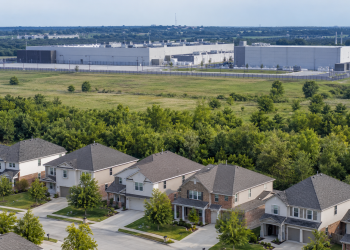

Data center traffic impacts are often misunderstood because people imagine constant activity, like a warehouse or big retail site. Most data centers do not operate with heavy daily public traffic. But that does not mean traffic is a non-issue. Communities usually experience the biggest disruption during construction, and they often worry about long-term truck deliveries, employee shift changes, and safety at key intersections and driveways.
This guide explains data center traffic impacts in plain English: what traffic changes during construction versus operations, what a credible traffic impact study (TIA) should include, what mitigation measures actually work, and what residents and local officials can verify during site plan review.
Key Takeaways
- Data center traffic impacts are usually highest during construction, when heavy trucks and hauling routes are most intense.
- Operational traffic is often moderate, but can still create pressure at peak times (shift changes, deliveries, maintenance events).
- A strong traffic impact study should quantify trip generation, truck volumes, peak hour impacts, and safety risks, not just “average daily traffic.”
- Mitigation is often practical: turn lanes, signal timing, driveway placement, construction routing plans, and enforceable truck restrictions.
- Communities can verify claims by requesting the full TIA scope, assumptions, and mitigation commitments as permit conditions.
Why Data Center Traffic Impacts Become Controversial
Traffic conflict usually happens when the community experiences disruption before it sees benefits. With data center traffic impacts, the timeline often looks like this:
- Construction starts and hauling traffic spikes immediately.
- Neighborhood roads experience heavy trucks, noise, and safety concerns.
- Residents ask, “Is this temporary or permanent?”
- The project transitions into operations, where traffic typically drops, but concerns shift to trucks, security, and expansions.
If your audience is looking for the broader “what changes when a data center arrives” framing, these internal pages pair well:
- What Happens When A Data Center Is Built Near You
- Community Opposition To Data Centers
- Public Records For Data Center Development
Construction vs Operations: Two Different Traffic Profiles
Construction Phase Traffic (Usually The Biggest Impact)
The construction phase often drives the strongest data center traffic impacts. This is when you see:
- Heavy trucks delivering concrete, steel, generators, chillers, and electrical gear
- Hauling routes for soil, aggregate, and demolition (if applicable)
- Worker commuting during early-morning start times
- Staging traffic for equipment and subcontractors
Construction traffic is also the phase most likely to create road damage concerns, curb conflicts, and safety issues around school routes and residential streets.
Operational Phase Traffic (Lower, But Not Zero)
Operational data center traffic impacts are often lower than many land uses, but still include:
- Employee trips (often smaller headcount than warehouses, but still real)
- Delivery and service vehicles (parts, maintenance vendors, fuel deliveries if applicable)
- Occasional heavy moves (equipment replacements, expansion phases)
Operational traffic risk is less about total daily volume and more about where traffic concentrates (a few key intersections) and how trucks access the site.
What A Traffic Impact Study Should Include For A Data Center
Traffic impact analysis is a standardized discipline used in land development review. The Institute of Transportation Engineers (ITE) describes transportation impact analysis for site development as a recommended practice for preparing and reviewing studies for new and expanding developments. ITE: Multimodal Transportation Impact Analysis For Site Development (MTIA).
At a minimum, a data center TIA should be built around transparent assumptions and a defensible scope. Many DOTs publish traffic impact analysis guidelines that outline what should be analyzed and how mitigation is documented; for example, Wisconsin DOT’s guide emphasizes assessing impacts and the need for mitigation for development proposals. WisDOT: Traffic Impact Analysis Guidelines (PDF). Caltrans provides similar structured guidance for traffic impact studies. Caltrans: Guide For The Preparation Of Traffic Impact Studies (PDF).
1) Clear Project Description And Phasing
A credible study must define what is being built and when. Data center traffic impacts can change dramatically between Phase 1 and Phase 3. The TIA should state:
- Construction timeline and major milestones
- Operational headcount assumptions
- Expected delivery patterns
- Expansion triggers and what changes with each phase
2) Trip Generation (Cars And Trucks)
Trip generation is the foundation of impact analysis. ITE’s Trip Generation resources explain that trip generation forecasting is a core tool used for estimating how many trips a land use produces. ITE: Trip Generation Information.
For data center traffic impacts, the study should separate:
- Construction trips (including heavy truck percentages)
- Operational trips (employees, visitors, service vendors)
- Heavy vehicles (deliveries, maintenance, fuel, specialized equipment moves)
Communities should be cautious when a study only reports “average weekday trips” without explicitly addressing truck volumes and peak construction hauling days.
3) Peak Hour Analysis And Shift Change Timing
Peak-hour impacts are where friction shows up at intersections and driveways. A strong TIA should analyze morning and afternoon peak periods and consider local sensitive times (school drop-off, commuter peaks).
When a data center uses 24/7 staffing, shift changes can create “mini peaks.” That can matter for a two-lane road with limited turning capacity.
4) Intersection And Driveway Capacity (Operations And Safety)
The study should evaluate whether key intersections and access points can handle projected volumes. FHWA notes that traffic studies predict impacts and support evaluation of alternative solutions, and it points practitioners to established traffic analysis methods and toolboxes. FHWA: Scoping And Conducting A Traffic Study and FHWA: Traffic Analysis Tools.
For data center traffic impacts, driveway design matters as much as intersection signals. Poor driveway placement can create rear-end risk, queue spillback, and turning conflicts with trucks.
5) Safety Analysis, Not Just “Level Of Service”
Communities increasingly want traffic studies to address safety, not only delay. FHWA provides guidance on incorporating data-driven safety analysis into traffic impact analyses. FHWA: Incorporating Data-Driven Safety Analysis In TIAs (PDF).
For a data center, safety concerns often focus on:
- Truck turning movements and off-tracking
- Stopping sight distance near driveways
- Pedestrian and bicycle conflict points (if nearby)
- Work zone safety during construction
6) Construction Traffic Management Plan (CTMP)
A TIA is often not enough unless it includes a construction traffic plan or ties to one. This is where data center traffic impacts become enforceable:
- Approved hauling routes (and restrictions from residential streets)
- Truck staging and queuing plans
- Work zone traffic control and signage
- Hours of operation for heavy hauling
FHWA’s work zone and traffic analysis resources emphasize planning for work zone impacts and mitigation strategies. FHWA: Work Zone And Traffic Analysis.

What Mitigation Measures Actually Work
When a study identifies significant data center traffic impacts, mitigation is typically a mix of geometric improvements, operations, and enforceable commitments.
Access And Geometry Improvements
- Dedicated turn lanes to prevent rear-end crashes and keep through traffic moving
- Driveway relocation to improve sight distance and reduce conflict points
- Truck-friendly turning radii to reduce curb strikes and off-tracking into opposing lanes
Signal Timing And Intersection Operations
- Signal timing optimization for peak periods
- Turn phasing changes where heavy truck turning is substantial
- Queue management to prevent spillback into upstream intersections
Construction Commitments
- Haul routes written into permit conditions
- Limits on heavy hauling hours (especially near schools or residential streets)
- Onsite staging that prevents trucks from queuing on public roads
Monitoring And “If-Then” Triggers
One of the best ways to manage data center traffic impacts over time is to require monitoring and triggers, especially for multi-phase builds. Examples:
- Post-occupancy traffic counts at defined milestones
- Mitigation required if volumes exceed modeled assumptions
- Re-study required before Phase 2 or Phase 3 approvals
What Communities Can Verify During Review
Communities can move traffic debates from opinions to facts by requesting specific documentation and commitments. If you are building a repeatable review playbook, start with:
- The full traffic impact study (not just an executive summary)
- Trip generation inputs and truck assumptions
- Intersection diagrams and analyzed scenarios (existing, background growth, with project)
- Construction hauling routes and enforcement mechanism
- Mitigation commitments written into permits or development agreements
This approach aligns well with your internal public-records workflow resource: Public Records For Data Center Development.
Frequently Asked Questions About Data Center Traffic Impacts
Do data centers create the same traffic as warehouses?
Usually not. Operational traffic is often lower than high-employment or high-delivery land uses. But data center traffic impacts can still be significant during construction and at a few key intersections where trucks and shift traffic concentrate.
What is the biggest traffic risk during construction?
Heavy trucks using local roads not designed for frequent hauling. That is why a construction traffic management plan and enforceable haul routes are so important for managing data center traffic impacts.
What should a traffic study prove before approval?
It should demonstrate (1) realistic trip generation including trucks, (2) peak-hour intersection performance, (3) safety impacts, and (4) mitigation that is funded and enforceable. Many agencies publish structured guidelines for what belongs in TIAs, such as WisDOT’s guidance. WisDOT Traffic Impact Analysis Guidelines (PDF).
Can communities require post-construction verification?
Yes, in many jurisdictions. Conditions can require traffic counts, operational monitoring, and additional mitigation if assumptions are exceeded. This is a practical way to keep data center traffic impacts aligned with what was promised during approval.
Bottom Line
Data center traffic impacts are usually manageable, but only when the project is studied honestly and mitigated early. The strongest projects treat construction traffic as the main disruption risk, quantify truck volumes instead of hand-waving them away, and commit to enforceable haul routes, intersection improvements, and monitoring triggers for phased expansion. The strongest communities focus on what can be verified: study assumptions, safety analysis, and permit conditions that turn mitigation into accountability.
Sources And Further Reading
- ITE: Multimodal Transportation Impact Analysis For Site Development (MTIA)
- ITE: Trip Generation Information
- WisDOT: Traffic Impact Analysis Guidelines (PDF)
- Caltrans: Guide For The Preparation Of Traffic Impact Studies (PDF)
- FHWA: Incorporating Data-Driven Safety Analysis In TIAs (PDF)
- FHWA: Work Zone And Traffic Analysis
- FHWA: Traffic Analysis Tools
- FHWA: Scoping And Conducting A Traffic Study