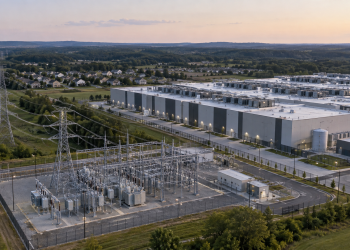
Data centers and the power grid are inseparable because data centers are large, always-on electricity users that depend on reliable power to maintain uptime. As more facilities are built for cloud and AI demand, grid infrastructure decisions are increasingly shaped by where data centers connect, how fast they scale, and what upgrades are required to serve them.
This article explains the grid in plain language, how data centers connect, what “capacity” really means, and why power planning has become a central issue for communities and regulators.
In one sentence: Data centers and the power grid
Data centers and the power grid interact through the interconnection process, where large loads connect at distribution or transmission substations and often trigger upgrades to keep the grid reliable.
Why data centers are a different kind of electric customer
Most electric customers are small relative to the grid and have variable usage patterns. Data centers are often the opposite: large, steady loads that operate 24/7 and scale in phases. That combination makes them powerful drivers of infrastructure investment.
For a plain-language foundation on why demand is so high, see why data centers use so much electricity. For growth drivers, see how AI and cloud drive data center growth.
Power grid basics: generation, transmission, and distribution
The “grid” is a system that moves electricity from power plants to end users. Understanding the three major layers helps explain why a new data center can require more than a simple line extension.
Generation
Generation is where electricity is produced, such as natural gas plants, wind farms, solar, hydro, or nuclear. Generation availability affects price and the carbon profile of electricity, but it is only one part of the delivery story.
Transmission
Transmission moves electricity long distances at high voltage. Transmission lines connect regions, balance supply and demand, and deliver power to major substations. Transmission upgrades can take years due to engineering complexity and permitting.
Distribution
Distribution delivers electricity locally at lower voltage to neighborhoods, commercial centers, and many industrial sites. Distribution upgrades can be faster than transmission, but large loads can still require new feeders, transformers, and sometimes entirely new substations.
The U.S. Energy Information Administration offers a helpful overview at Electricity explained.
Where data centers connect: substations and voltage levels
Data center power connections typically revolve around substations. A substation is where voltage is transformed and where switching equipment controls power flows.
Data centers may connect at:
- Distribution-level substations if the load is within local capacity and the utility can serve it with distribution infrastructure.
- Transmission-level substations for very large loads or when distribution capacity is constrained.
In many markets, the bottleneck is not the data center building itself. It is transformer availability, substation capacity, and the time needed for grid upgrades.
The interconnection process: how a data center gets power
Interconnection is the process of formally connecting a customer or facility to the grid under technical and regulatory rules. For large data center loads, utilities and grid operators typically require studies to confirm the system can serve the load safely.
Step 1: Load request and preliminary screening
The developer provides expected demand (often in megawatts), phasing plans, and site details. The utility checks nearby infrastructure and identifies potential connection points.
Step 2: System studies
Utilities and regional grid entities may perform studies to assess:
- Thermal limits (can lines and transformers carry the load without overheating?).
- Voltage stability (does the load create unacceptable voltage drops?).
- Short-circuit impacts (does fault current exceed equipment ratings?).
- Reliability impacts (does serving the load require new redundancy?).
Step 3: Upgrade scope and cost responsibility
If upgrades are required, the parties define what will be built and who pays. Depending on jurisdiction and tariff rules, costs may be assigned to the project, shared, or recovered over time through rates.
Step 4: Construction and energization
After agreements are executed, utilities procure equipment, build infrastructure, test systems, and energize the service. Supply chain constraints for transformers and switchgear can materially affect timelines.
Why “capacity” is not just one number
Communities often hear a utility say “we have capacity” or “we do not have capacity,” but capacity is multi-dimensional.
- Local substation capacity: transformer size, feeder limits, and redundancy margin.
- Transmission deliverability: whether regional lines can move enough power to the area.
- Generation adequacy: whether supply exists during peak conditions.
- Queue and timing: whether other projects are already scheduled to consume the same capacity.
This is why data centers are often built in specific corridors with proven power infrastructure. See why data centers are built in specific locations.

Grid reliability: redundancy, outages, and what data centers do differently
Data centers are designed around uptime targets. Most cannot tolerate extended outages, so they build layers of resilience that go beyond what a typical commercial building requires.
Utility redundancy versus on-site redundancy
Some facilities seek dual utility feeds or multiple substations, but this is not always available. Instead, data centers typically combine utility service with on-site systems:
- Uninterruptible power supplies (UPS) to bridge short interruptions and maintain clean power.
- Backup generators to provide extended runtime during outages.
- Fuel systems sized for expected outage durations and refueling logistics.
For a broader overview of facility systems and redundancy, see how data centers work.
How data centers can change peak demand and planning
Because data centers run continuously, they add a “baseload-like” demand to the grid. That can increase the need for generation and transmission capacity and can affect how utilities plan for peaks, especially in hot weather when air conditioning demand is also high.
However, not all demand is equally rigid. Some operators explore flexibility strategies, including:
- Demand response: temporarily reducing load when the grid is stressed.
- Load shifting: moving non-urgent workloads to different times or regions.
- On-site energy systems: using batteries or other assets to reduce peak draw.
These strategies can help, but they depend on workload design, market rules, and strong operational coordination.
Community and permitting implications
Grid infrastructure is a common driver of community concern, especially when residents worry about rate impacts, new transmission corridors, or expanded substations near neighborhoods.
These concerns often surface during approvals. See community opposition to data centers and zoning and permitting for data centers.
Economic incentives can also become part of the debate when grid upgrades are large. See tax incentives for data centers.
What to ask when a new data center is proposed
If you are evaluating a project in your area, these questions keep discussions concrete:
- What is the expected maximum load (in MW) at full build-out, and how will it phase in?
- Where will the facility interconnect: distribution or transmission?
- What specific upgrades are required: transformers, feeders, substations, or transmission lines?
- What is the expected timeline for upgrades, including equipment lead times?
- How will costs be allocated between the project and ratepayers?
- What resilience measures are planned for outages, and how often will generators be tested?
Summary
Data centers and the power grid are linked through large-load interconnections that often require new substations, transformer capacity, and sometimes transmission upgrades. As cloud and AI demand accelerates, power availability and upgrade timelines increasingly determine where data centers can be built and how quickly they can scale. For communities, the key is transparency: clear load numbers, specific infrastructure plans, and a realistic view of costs, timelines, and reliability impacts.
FAQ
Do data centers connect to the transmission grid or the distribution grid?
Both are possible. Smaller or moderate loads often connect at distribution substations, while very large loads or constrained areas may require transmission-level interconnection.
Why do data centers trigger grid upgrades?
Large, steady loads can exceed existing substation or feeder capacity and may require new transformers, additional feeders, or broader transmission upgrades to maintain reliability.
Will a new data center increase electricity rates?
It depends on how upgrade costs are allocated and how utilities recover investments. Some costs may be assigned to the project, while others may be recovered through rates under local rules.
How long does it take to get power for a data center?
Timelines vary by region and upgrade scope. Equipment lead times for transformers and switchgear, plus permitting for major upgrades, can extend schedules significantly.
Why do data centers use backup generators if the grid is reliable?
Even reliable grids experience outages. Data centers use UPS systems and generators to maintain uptime during interruptions, especially for critical services.
Can data centers help the grid instead of stressing it?
Sometimes. Through demand response, load shifting, and energy storage, some operators can reduce peak draw or provide flexibility, but it depends on workload design and market participation.
For additional authoritative context on how the grid is planned and operated in the U.S., see FERC power markets overview.