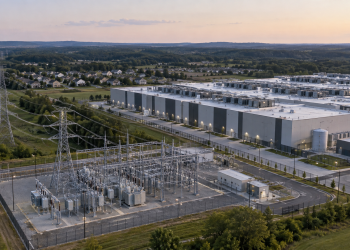
GPU clusters and compute fabrics are the backbone of modern AI training and many high-performance computing environments. A single GPU is powerful, but most large models are trained by connecting many GPUs together so they can work in parallel. The network that links those GPUs is not a minor detail. It is a core performance constraint that determines how efficiently expensive accelerators can be used.
This guide explains GPU clusters and compute fabrics in plain language, including what a “fabric” is, how clusters scale, why latency matters, and how these systems change data center design and infrastructure planning.
In One Sentence: GPU Clusters And Compute Fabrics
GPU clusters and compute fabrics connect many GPUs with low-latency, high-bandwidth networks so AI training can scale across nodes without wasting time waiting for data to move.
What Is A GPU Cluster?
A GPU cluster is a group of servers equipped with GPUs that work together on a shared problem. In AI training, the problem is usually splitting model computation and data across many GPUs so training finishes faster and larger models become feasible.
Clusters can range from a few racks to large-scale deployments that take up entire data halls. As clusters grow, the network becomes as important as the compute hardware, because GPUs spend a lot of time exchanging gradients and parameters during training.
For broader AI-driven facility changes, see how AI workloads change data center design and how AI and cloud drive data center growth.
What Is A Compute Fabric?
A compute fabric is the high-speed network that connects servers and GPUs inside a data center cluster. It is designed for predictable, low-latency communication and very high bandwidth, often with features that reduce CPU overhead and improve efficiency for distributed workloads.
In traditional enterprise networks, many applications tolerate variable latency. In AI training, unpredictable latency can slow the entire job because many training steps must synchronize across GPUs. This is why GPU clusters and compute fabrics are designed with performance determinism in mind.
Why Networking Becomes The Bottleneck In AI Training
AI training involves frequent data exchange between GPUs. If the fabric cannot deliver data quickly enough, GPUs sit idle. That is expensive because GPU time is valuable, and clusters are often built specifically to maximize GPU utilization.
Three concepts explain most of the performance sensitivity:
- Bandwidth: how much data the fabric can carry per second.
- Latency: how long it takes a message to travel between nodes.
- Congestion: how traffic patterns cause contention and slowdowns at scale.
Common Fabric Technologies: InfiniBand And Ethernet
GPU clusters and compute fabrics are often built on either InfiniBand or advanced Ethernet, and sometimes a blend depending on the environment and vendor ecosystem.
InfiniBand
InfiniBand is widely used in HPC and AI training because it is designed for low latency and high throughput. It commonly supports RDMA (Remote Direct Memory Access), which enables data transfer with less CPU involvement.
Ethernet Fabrics
Ethernet is ubiquitous in data centers, and modern Ethernet fabrics can support high performance at scale when designed correctly. Technologies like RDMA over Converged Ethernet (RoCE) are used to enable RDMA-like behavior over Ethernet.
The choice is rarely purely technical. It also depends on operational maturity, vendor support, and how the fabric integrates with the rest of the data center network.
How GPU Clusters Scale: Data Parallel, Model Parallel, And Pipeline Approaches
Training large models typically uses one or more parallelization strategies. You do not need to be an AI engineer to understand the infrastructure implications.
- Data parallel: GPUs process different batches of data and synchronize results.
- Model parallel: the model is split across GPUs because it is too large for one device.
- Pipeline parallel: different stages of the model run on different GPUs in sequence.
All of these strategies increase inter-GPU communication, which is why compute fabrics become a limiting factor at scale.
What GPU Clusters Change In Data Center Design
GPU clusters and compute fabrics influence physical design because cabling density, power density, and cooling needs rise together.
Higher Power Density And Heat Density
AI racks often draw far more power than traditional enterprise racks. That affects electrical distribution, redundancy planning, and often pushes cooling strategy toward liquid options.
For cooling trends, see why liquid cooling is increasing with AI demand and how data center cooling systems work.
Cabling And Physical Topology
Large fabrics require extensive cabling, and the physical layout of racks can affect network design. Shorter cable runs can reduce loss, simplify management, and support denser connectivity patterns.
Rack Layout And Cluster Zoning
Operators often design “AI pods” or cluster zones to keep related compute close together, reduce cross-traffic, and simplify the fabric. This can affect how data halls are segmented and expanded.

Why Power And Grid Planning Still Matter
Even if your cluster is world-class, it still needs reliable deliverable power. AI clusters increase peak demand and can accelerate the need for substation and feeder upgrades.
Use data centers and the power grid and how utilities plan for data center growth to understand the upstream constraints that can delay deployments.
Efficiency And Reporting: How To Interpret Claims
GPU clusters can drive high utilization, but they can also drive high energy consumption due to the scale of the IT load. Efficiency claims should be evaluated using consistent metrics and clear boundaries.
Use PUE and WUE metrics explained to interpret facility efficiency, and use renewable energy and PPAs for data centers to understand procurement claims.
Common Misconceptions About Compute Fabrics
- “The fabric is just a faster version of a normal network.” AI fabrics are designed for deterministic performance, not just higher bandwidth.
- “More GPUs always means faster training.” Scaling can stall if networking, storage, or software synchronization becomes the bottleneck.
- “Ethernet cannot support AI training.” Modern Ethernet fabrics can perform well, but they require careful design and congestion control.
- “Cooling and power are separate from networking decisions.” They are linked because dense AI pods concentrate compute, heat, and cabling together.
Practical Questions To Ask When Evaluating A GPU Cluster
- What cluster size is planned, and what is the scaling target over time?
- What fabric technology is used, and how is congestion managed?
- What is the expected bandwidth and latency between nodes?
- How is the cluster physically laid out to support cabling and expansion?
- How does the design handle power density and cooling at full utilization?
Authoritative References
For background on cloud computing characteristics and distributed system delivery models, see NIST SP 800-145 cloud definition. For broader analysis of digitalisation and energy demand that frames why AI and compute growth matter, see IEA digitalisation and energy resources.
Summary
GPU clusters and compute fabrics enable large-scale AI training by connecting many GPUs with networks designed for high bandwidth and low latency. The compute fabric often becomes the primary constraint because distributed training requires constant synchronization between nodes. As a result, GPU cluster design affects not only networking, but also power density, cooling strategy, physical layout, and grid interconnection planning. Understanding these relationships helps decision-makers evaluate AI infrastructure claims and plan realistic deployments.
FAQ
What Is The Difference Between A GPU Cluster And A Compute Fabric?
A GPU cluster is the set of GPU-equipped servers working together. The compute fabric is the high-speed network that connects them so they can coordinate and share data efficiently.
Why Does Latency Matter So Much For AI Training?
Many training steps require GPUs to synchronize. If communication is slow or inconsistent, GPUs wait, and overall training speed drops even if compute power is high.
Is InfiniBand Required For AI Training?
No, but it is common in HPC and AI environments because it is optimized for low latency and high throughput. Modern Ethernet fabrics can also support AI workloads when designed correctly.
What Does RDMA Do In A Compute Fabric?
RDMA enables data to move between systems with less CPU overhead, improving performance and reducing latency, which can increase training efficiency at scale.
How Do GPU Clusters Affect Data Center Cooling?
GPU racks can be very power dense and generate concentrated heat. This often increases the need for advanced airflow management or liquid cooling approaches.
What Is The Biggest Non-Technical Constraint On GPU Cluster Deployment?
Deliverable power is often the biggest constraint. Utility interconnection, substation capacity, and equipment lead times can delay deployments even when hardware is available.