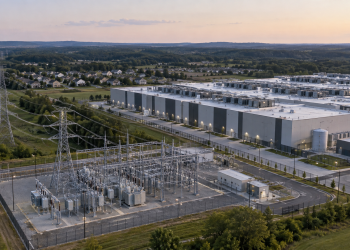

PUE and WUE metrics are the two most common measures used to explain how efficiently a data center uses electricity and water. They show how much overhead a facility requires beyond the IT equipment that actually does the computing, and they help operators and stakeholders compare designs, track improvements, and communicate sustainability outcomes.
This guide explains what PUE and WUE mean, how they are calculated, what they do and do not tell you, and how to use them without oversimplifying complex infrastructure realities.
In One Sentence: PUE And WUE Metrics
PUE and WUE metrics quantify data center efficiency by comparing total facility energy to IT energy (PUE) and annual water use to IT energy (WUE), helping benchmark overhead and resource intensity.
Why PUE And WUE Exist
Data centers use electricity for both computing and everything that supports computing, such as cooling and power delivery. Some data centers also use water, mainly for heat rejection in evaporative cooling systems. PUE and WUE are designed to make those supporting costs visible.
For background on why electricity and water matter, see why data centers use so much electricity and why data centers use water.
PUE Explained
PUE stands for Power Usage Effectiveness. It compares how much total power the data center consumes to how much power the IT equipment consumes.
How PUE Is Calculated
PUE is calculated as:
- PUE = Total Facility Energy / IT Equipment Energy
Total facility energy includes IT load plus cooling, lighting, UPS losses, transformers, pumps, fans, and other supporting systems. IT energy is the electricity delivered to servers, storage, and networking equipment.
How To Interpret PUE
A PUE closer to 1.0 indicates less overhead. For example:
- PUE 1.2 suggests 20% overhead beyond IT energy.
- PUE 1.5 suggests 50% overhead beyond IT energy.
But PUE is not a universal scorecard. A facility can have a strong PUE and still have high emissions if the local grid is carbon intensive.
For how power and grid constraints shape development, see data centers and the power grid and data center electricity.
WUE Explained
WUE stands for Water Usage Effectiveness. It links how much water a data center uses to the amount of IT energy it delivers, typically expressed as liters per kilowatt-hour (L/kWh).
How WUE Is Calculated
WUE is commonly calculated as:
- WUE = Annual Site Water Use / IT Equipment Energy
Water use typically includes water consumed by evaporative cooling systems, such as cooling towers, and may include other operational uses depending on the reporting boundary. IT equipment energy is measured similarly to PUE, but you should confirm whether the denominator is annual IT kWh.
How To Interpret WUE
Lower WUE generally means less water use per unit of computing energy delivered. However, WUE is strongly influenced by:
- Cooling design (air cooling, liquid cooling, hybrid heat rejection).
- Climate (temperature and humidity affect how often evaporative cooling is used).
- Operational strategy (setpoints and economizer usage).
- Water source (potable vs reclaimed, where available).
For deeper cooling context, see how data center cooling systems work and data center water rights.
What PUE And WUE Do Not Tell You
PUE and WUE are helpful, but they are not full sustainability assessments. Over-reliance can create misleading comparisons.
They Do Not Measure Carbon Emissions Directly
Carbon depends on the grid’s generation mix, renewable procurement, and time-of-use patterns. Two data centers with identical PUE can have very different emissions.
They Do Not Capture All Water Impacts
WUE measures site water use, but it may not capture water consumed in power generation upstream, or broader watershed stress. It also does not automatically distinguish between potable and reclaimed sources unless reported separately.
They Can Be Influenced By Measurement Boundaries
Where meters are placed and what is included in “total facility” can change the result. If one facility includes office space or other loads and another does not, comparisons can be distorted.
How Operators Improve PUE
Improving PUE usually means reducing overhead in cooling and power delivery while maintaining reliability.
- Improve airflow management with hot aisle and cold aisle containment.
- Increase cooling efficiency through optimized setpoints, economizers, and variable speed drives.
- Reduce electrical losses by using efficient UPS topologies and minimizing unnecessary conversions.
- Optimize capacity utilization so systems are not running far below design load.
Backup power design affects overhead and operating practice. See backup power for data centers.
How Operators Reduce WUE
Reducing WUE often involves changing how heat is rejected and how water is sourced.
- Use water-lean cooling strategies, such as dry coolers or hybrid systems, where climate and economics allow.
- Optimize evaporative systems to reduce blowdown and improve cycles of concentration, within safe limits.
- Use reclaimed water where available to reduce reliance on potable supply.
- Adopt targeted liquid cooling to handle high-density zones efficiently.
For broader policy and community context, see community opposition to data centers.

Best Practices For Reporting PUE And WUE
Transparent reporting helps stakeholders interpret metrics correctly. Practical best practices include:
- Report annual averages and ranges rather than a single “best day” number.
- Define boundaries clearly for what loads are included.
- Separate potable and non-potable sources where possible for water reporting.
- Provide context on climate, cooling design, and operating setpoints.
- Pair with carbon metrics where possible to avoid false conclusions.
For an industry reference point, The Green Grid is often cited for PUE guidance and definitions; see PUE guidance from The Green Grid.
Summary
PUE and WUE metrics are useful tools for understanding data center efficiency, but they work best when used with context. PUE highlights energy overhead beyond IT, while WUE highlights how much water is used per unit of IT energy. Neither metric fully captures carbon emissions, watershed stress, or measurement boundary differences, so responsible comparisons require transparency and supporting data.
FAQ
What Is A Good PUE For A Data Center?
“Good” depends on facility type, climate, and design. Modern large facilities often target low PUE values, but the most meaningful comparison is how a site improves over time under consistent measurement boundaries.
Does A Low PUE Mean A Data Center Is Sustainable?
Not by itself. Low PUE means less energy overhead, but sustainability also depends on carbon intensity of electricity and other environmental factors.
What Is The Difference Between WUE And Water Use?
Water use is the total amount of water consumed. WUE normalizes water use against IT energy delivered, allowing comparisons across time and scale when boundaries are consistent.
Can A Data Center Reduce WUE Without Changing Cooling Technology?
Sometimes. Improvements can come from optimizing tower chemistry and blowdown, adjusting setpoints, improving controls, and using reclaimed water where available.
Do PUE And WUE Apply To Colocation And Edge Sites?
Yes, but smaller sites often have different constraints and measurement challenges. Comparisons should account for scale, utilization, and metering granularity.
Where Can I Find Standard Definitions For These Metrics?
The Green Grid and related industry groups publish widely referenced definitions and guidance for PUE, and many operators align reporting with those frameworks.