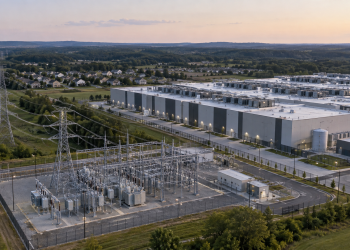
Time-to-power for data centers is the real-world time it takes to go from “we have a site” to “we have enough reliable, permitted, deliverable electricity to actually turn the facility on.” In fast-growing markets, a building can be ready before the power is. That mismatch is why time-to-power has become one of the biggest drivers of delay, cost overruns, and community tension around new data center projects.
If you want the baseline grid context first, start with data centers and the power grid. If you want the technical chokepoints that keep showing up in project schedules, read the substation and transformer bottleneck.
Time-to-Power for Data Centers in One Sentence
Time-to-power for data centers is the end-to-end timeline to secure enough utility capacity and infrastructure so the site can be energized reliably and legally at its planned load.
What Time-to-Power Actually Includes
People often assume “power” means a nearby line or a utility bill. For data centers, “power” means something more specific: contracted capacity, a deliverable interconnection plan, and the physical equipment (lines, breakers, transformers, substations) to move electrons safely to the site at scale.
Time-to-power typically includes multiple parallel tracks:
- Utility load service studies to confirm the system can serve the requested megawatts without violating reliability constraints
- Interconnection and upgrade work that may require substation expansion, new feeders, or transmission-level changes
- Equipment procurement for switchgear, transformers, and protection systems
- Permitting and inspections for electrical and site work, plus environmental approvals where applicable
- Construction and commissioning so the utility can energize safely and the facility can accept load
This is why time-to-power is often discussed like a pipeline problem. The limiting factor is rarely just one thing; it is the slowest dependency in a chain.
Why Time-to-Power for Data Centers Causes Delays
Time-to-power delays usually come from three categories: queueing, infrastructure, and constraints.
1) Queueing: Studies, Milestones, and Interconnection Backlogs
Across the U.S., power systems are handling more interconnection and upgrade requests than their planning and engineering processes were designed to study quickly. At the federal level, the Federal Energy Regulatory Commission has been working to reform interconnection processes to reduce delays and improve study discipline, including changes described in its interconnection final rule explainer. FERC’s interconnection final rule overview is a good reference for why study reforms exist and what they aim to improve.
Even if a data center is a load (not a generator), it can still be affected by the same system realities: constrained engineering resources, long study timelines, and upgrade sequencing. This is why project teams pay close attention to the interconnection queue and what it signals about realistic energization timelines.
2) Infrastructure: Substations, Feeders, and Transformers
Large loads often require new distribution feeders, protection upgrades, or entirely new substation capacity. In many regions, the constraint is not willingness, it is physical buildout and equipment availability. The U.S. Department of Energy has highlighted how large power transformers are custom, difficult to transport, and come with long manufacturing and installation timelines in its Large Power Transformer Resilience report.
For community readers, the practical takeaway is simple: if the project requires major electrical equipment that is not already staged locally, schedules can slip even when the site work is progressing. This shows up most clearly in the substation-and-transformer timeline, which is why those assets are often called out explicitly in development filings and utility discussions.
3) Constraints: Reliability, Land, and Permitting Sequencing
Utilities and grid operators cannot energize new capacity if it would violate reliability criteria. In some cases, there may be plenty of generation in the region but limited ability to move power where it is needed without upgrades. Grid operators also maintain structured interconnection and study guidance; for example, ISO New England publishes an interconnection process guide that illustrates how formal these timelines and steps can be in practice.
On top of electrical constraints, construction and energization are gated by local approvals. Even when a utility is ready, the site may not be legally ready. This is why permitting timelines often become part of the time-to-power story, especially when projects require offsite utility work that crosses multiple jurisdictions.
What Time-to-Power for Data Centers Means for Communities
Time-to-power shapes what communities experience because it changes the cadence of the project. A site can look “mostly done” and still sit in a holding pattern while waiting for upgrades, inspections, or equipment delivery. That limbo period can affect public perception, local traffic and construction impacts, and even local planning decisions.
It also affects the cost side. If upgrades are needed, someone has to pay for them, and the rules are not always intuitive. For the cost-allocation basics, who pays for grid upgrades for data centers explains the common frameworks communities hear about in hearings and utility discussions.
How Developers Try to Improve Time-to-Power for Data Centers
Because time-to-power for data centers can make or break a project, developers and operators tend to focus on a few levers that are practical (and a few that are not).
- Site selection near “ready” capacity where substations and feeders have headroom, even if land costs are higher
- Phased builds that energize smaller blocks of load earlier while larger upgrades catch up
- Earlier utility engagement so studies and design work begin before land closes or buildings are finalized
- Clearer documentation in public filings so timelines, dependencies, and upgrade scope are not guesswork
What does not usually help is assuming speed can be “negotiated” out of physical constraints. If the system needs a new transformer, it needs a new transformer, and that becomes a supply-chain and installation reality, not just a project management problem.

Practical Summary
Time-to-power for data centers is the timeline to get real, usable, permitted electrical capacity to a site, not just the time to finish the building. Projects get delayed when studies and upgrades take longer than planned, when substations and transformers become bottlenecks, or when permitting and inspection sequencing slows energization.
The most useful community questions tend to be concrete: What upgrades are required? Who is responsible for them? What is the energization sequence? And what conditions must be met before the utility will turn the site on?
Frequently Asked Questions
Is time-to-power for data centers the same as “permitting time”?
No. Permitting is one component. Time-to-power includes utility studies, infrastructure buildout, equipment delivery, inspections, and energization readiness. Local permitting can be the limiting factor in some projects, but grid work often drives the long pole in others.
Why can a data center be built before power is available?
Buildings and site work are often easier to schedule than utility upgrades that depend on studies, procurement, and outages for tie-ins. A project may proceed on the assumption that power will arrive by a target date, and then slip if an upgrade dependency moves.
Does time-to-power for Data Centers always mean the grid is “maxed out”?
No. Delays can happen even in regions with significant generation. Constraints can be local (distribution capacity), regional (transmission deliverability), procedural (study timelines), or equipment-related (transformers and switchgear availability).
Where can I find the most reliable information for a specific project?
Start with the project’s public filings and utility-related documents, then look for explicit language on required upgrades, energization milestones, and timelines. A good process for finding those documents is outlined in public records for data center development.
What is the single biggest driver of time-to-power delays right now?
It varies by region, but common drivers include interconnection and study backlogs, the scope of required upgrades, and long lead times for critical electrical equipment. Federal and grid-operator reforms are aimed at improving timelines, but physical buildout and supply constraints can still dominate schedules.