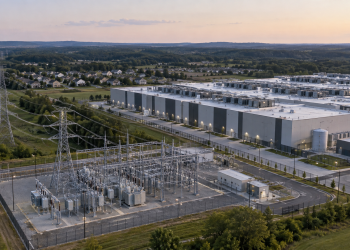
What is a data center? A data center is a secure facility designed to run servers, storage, and networking equipment so applications and digital services can operate reliably 24/7. When you stream a video, send an email, use cloud software, or interact with AI tools, you are depending on data center infrastructure somewhere to process and deliver that experience.
Because data centers support always-on services, they are built differently than ordinary office buildings. A modern data center facility is engineered around uptime, safety, and resilience. Power must stay stable. Cooling must stay consistent. Networks must stay fast. Operations must stay disciplined.
This guide answers the foundational question, “what is a data center,” then breaks down how a data center works at a practical level, what systems exist inside the building, and how the main types of data centers differ.
Data Center Definition
Data center definition: A data center is a purpose-built facility that houses IT hardware (servers, storage, and networking) and the supporting systems required to keep that hardware running continuously. Those supporting systems include electrical distribution, backup power, cooling, fire protection, physical security, and monitoring.
If you want a simpler way to say what is a data center, think of it as a highly controlled environment for computing. It is not “the cloud” itself, but it is where cloud computing runs. It is also not just a room full of computers. It is an engineered system designed to keep services online during failures, maintenance, and demand spikes.
For the deeper facility-level walkthrough, see how data centers work.
What Is a Data Center Used For?
People ask what is a data center because they want to understand what it actually does. At a high level, a data center is used to provide the computing resources behind digital services. Those resources generally fall into three categories.
- Compute: Running applications and processing workloads on CPUs and GPUs.
- Storage: Saving and serving data through databases, file systems, and object storage.
- Networking: Moving data between servers and out to users, offices, and other data centers.
That sounds abstract until you connect it to real life. A data center powers collaboration apps, payment processing, telehealth, logistics, video streaming, gaming, weather models, research workloads, and AI training clusters. In short, what is a data center used for? It is used to run the digital world.

Data Center Infrastructure: The 7 Essential Components
To fully answer what is a data center, you need to understand the systems that make a data center facility reliable. The IT hardware is only part of the story. The supporting infrastructure is what turns hardware into a dependable service platform.
1) Servers and Compute Hardware
Servers are the core machines that run applications. Inside a modern data center, servers are typically installed in racks and organized into aisles. Many facilities also deploy GPU servers for AI workloads and high-performance computing.
As compute density increases, power and cooling requirements rise. That is one reason the question “what is a data center” often leads directly into questions about electricity, grid upgrades, and energy planning.
2) Storage Systems
Storage systems keep data available and protected. This includes high-performance storage for databases, scalable object storage for large datasets, and backup systems for recovery. Storage is engineered for both speed and resilience, often using redundancy so data remains available during component failures.
3) Networking and Connectivity
Networking equipment connects everything together. Inside the data center, switches connect racks to core networks. Routers connect the facility to outside networks and upstream carriers. Fiber cabling is common for speed and capacity.
Many large facilities include interconnection spaces where multiple carriers and customers meet. This connectivity is often a deciding factor for businesses choosing a colocation data center because it makes it easier to connect to cloud providers, partners, and internet exchanges.
4) Power Delivery and Backup Power
Power is a defining trait of data center infrastructure. A data center facility is designed to deliver steady electricity to IT equipment while also handling outages gracefully. Typical power systems include utility feeds, transformers, switchgear, UPS systems, batteries, generators, and power distribution units.
Because uptime is a priority, power is built with redundancy. Even brief power interruptions can cause service disruption, so the facility is engineered to prevent single points of failure.
For a deeper look at energy demand, see why data centers use so much electricity. For the broader infrastructure context, see data centers and the power grid.
5) Cooling Systems
Servers generate heat as they operate. Cooling systems remove that heat to keep equipment within safe operating temperatures. Cooling approaches vary by facility design and workload density. Common approaches include air cooling with hot aisle/cold aisle containment, chilled-water systems, and increasingly, liquid cooling for high-density AI.
Cooling design often influences location decisions and utility partnerships. In some regions and architectures, water is part of the cooling strategy. If you want the full explanation, see why data centers use water.
6) Physical Security and Safety
A data center is treated as critical infrastructure. Physical security typically includes controlled access points, surveillance, perimeter measures, and strict visitor processes. Safety systems include fire detection and suppression strategies designed to protect both people and equipment.
Security is a major reason companies choose data centers rather than running sensitive workloads in generic office spaces.
7) Operations, Monitoring, and Maintenance
A data center facility is operated continuously. Teams monitor power load, cooling performance, airflow, humidity, and network health. They also track capacity, plan expansions, and run maintenance procedures that avoid downtime.
This operational discipline is part of the answer to what is a data center. A data center is not just equipment. It is equipment plus process plus engineered redundancy.
How Data Centers Work in Practice
When people ask what is a data center, they often want to understand the “day-to-day” reality. In practice, data centers work by balancing three constant priorities: reliability, efficiency, and scalability.
Reliability comes from redundancy and disciplined operations. Efficiency comes from power management, cooling design, and utilization strategies. Scalability comes from standardized deployment patterns and capacity planning.
If you want a full walk-through of the physical systems, read how data centers work.
Types of Data Centers
To understand what is a data center in the real world, you also need to understand that “data center” is an umbrella term. There are multiple types of data centers, each with a different purpose and operating model.
Enterprise Data Center
An enterprise data center is owned and operated by a single organization. It supports that organization’s internal workloads. Some enterprises maintain their own facilities for regulatory requirements, performance needs, or direct control over infrastructure.
Colocation Data Center
A colocation data center provides building space, power, cooling, and connectivity. Customers install their own servers and rent capacity. Colocation is common for hybrid architectures, predictable costs, and high-connectivity needs.
Hyperscale Data Center
A hyperscale data center is a very large facility designed to scale efficiently. Hyperscale operators (often cloud providers or large platforms) use standardized designs, automation, and supply-chain advantages to deploy massive capacity quickly.
Edge Data Center
An edge data center is a smaller facility placed closer to users or devices. Edge sites reduce latency and support real-time workloads such as industrial systems, content delivery, and regional services.
For a direct comparison of the main types of data centers, see hyperscale vs colocation vs edge.
Cloud Computing Data Center: Is the Cloud a Data Center?
Many readers ask what is a data center because the cloud can feel abstract. The cloud is not a separate universe. It runs on physical infrastructure in real buildings.
A cloud computing data center is simply a data center used to deliver cloud services. The difference is not the building. The difference is the service model: virtualization, automation, and on-demand provisioning let customers consume compute and storage as a service.
That is why “the cloud” still depends on electricity, cooling, fiber connectivity, and operators. The cloud is a software and service layer built on top of data center infrastructure.
Why Data Centers Need So Much Electricity
What is a data center without power? It does not exist. Power is one of the largest operating considerations for any data center facility.
Electricity is required to run servers and also to run the supporting systems that keep those servers safe and reliable. Backup power systems, cooling systems, and distribution equipment all contribute to demand. As AI workloads grow, power density increases and electricity planning becomes even more important.
For the full breakdown, read why data centers use so much electricity.
Why Data Centers Use Water
Not every facility uses water in the same way, but many do. Water use is often connected to cooling strategy. Some cooling designs rely on evaporative cooling or chilled-water systems that consume water directly or indirectly through cooling towers.
Water use is also a regional issue. Climate, local utility capacity, and sustainability policies influence whether water-based cooling is common and how it is managed.
For a practical explanation, read why data centers use water.
Data Centers and the Power Grid
As data center demand grows, communities and utilities increasingly focus on grid impact. Large facilities can require new substations, transmission upgrades, and long lead-time equipment. Energy planning becomes part of regional economic planning.
To understand how this fits together, read data centers and the power grid.
What Makes a Data Center Reliable?
Reliability is the central promise behind a data center facility. Reliability is not one feature. It is a strategy implemented across design, operations, and redundancy.
Redundancy Models
Redundancy is often described using patterns such as N+1 and 2N. While details vary, the principle is the same: the facility is designed so that a single failure does not cause downtime.
- N+1: One extra component beyond what is needed for normal operation.
- 2N: Fully duplicated systems, often with independent power paths.
- Distributed resiliency: Multiple data centers supporting failover between regions.
Operational Discipline
Procedures matter. Change management, maintenance windows, incident response practices, and monitoring standards all contribute to uptime. The more mature the operations, the fewer surprises occur in production environments.
Key Metrics Used to Describe a Data Center
When evaluating what is a data center, you will often encounter a few common metrics. These metrics help describe efficiency, capacity, and performance in a standardized way.
- Uptime: How consistently services remain available.
- PUE: Power Usage Effectiveness, a measure of how efficiently facility power supports IT load.
- WUE: Water Usage Effectiveness, a measure of water consumption relative to IT energy usage.
- Latency: The delay between users and services, often improved by edge deployments.
- Power density: The amount of power per rack, which is increasingly important for AI workloads.
For additional background on data centers and energy use, the U.S. Department of Energy provides a high-level overview here: Data Centers and Servers (DOE).
Where Are Data Centers Built, and Why?
Location is not random. Data centers are often built where the combination of power availability, fiber connectivity, land, climate, and permitting timelines creates a viable project.
Many large builds occur near major fiber routes and metro regions. Others occur in areas where utilities can support large loads and where land and zoning allow expansion. Climate can matter because cooler ambient temperatures can improve efficiency in certain designs.
If you want the full location rationale, read why data centers are built in specific locations.
Common Misconceptions About What a Data Center Is
“A data center is just a warehouse full of computers.”
It is true that servers are inside. But what makes a data center a data center is the engineered environment around those servers. Power, cooling, security, and monitoring are essential parts of data center infrastructure.
“The cloud is separate from data centers.”
The cloud runs inside data centers. Cloud is a delivery model. Data centers are the physical facilities that provide the compute and storage behind cloud services.
“All types of data centers are basically the same.”
Enterprise, hyperscale, colocation, and edge facilities have different designs, economics, and operational priorities. Understanding the types of data centers helps explain why some projects are huge campuses while others are small edge sites.
What Is a Data Center? A Practical Summary
What is a data center? A data center is a secure facility that houses servers, storage, and networks along with the power, cooling, security, and monitoring systems required to run digital services continuously. Data centers power cloud computing, support AI workloads, and keep modern businesses and daily life online.
To learn more about industry practices, Uptime Institute is a widely cited resource for data center resiliency concepts: Uptime Institute. For a security and standards perspective, NIST is a primary reference point: NIST.
Frequently Asked Questions
What is a data center in simple terms?
What is a data center in simple terms? A data center is a specialized building that runs lots of computers (servers) safely so websites, apps, and cloud services work all the time.
What is a data center used for?
What is a data center used for? A data center is used to run applications, store data, and move network traffic for cloud platforms, businesses, and online services.
Is a data center the same as the cloud?
No. What is a data center versus the cloud? The cloud is a service model. A data center is the physical facility where cloud servers and systems operate.
What are the main types of data centers?
The main types of data centers are enterprise data centers, colocation data centers, hyperscale data centers, and edge data centers.
Why are data centers important?
What is a data center’s role in everyday life? Data centers are important because they power communication, finance, healthcare, public services, entertainment, and cloud computing at massive scale.