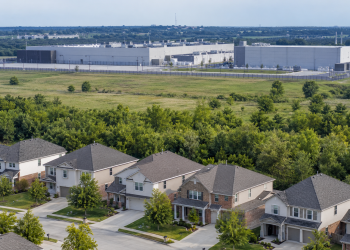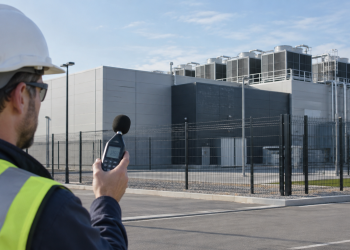
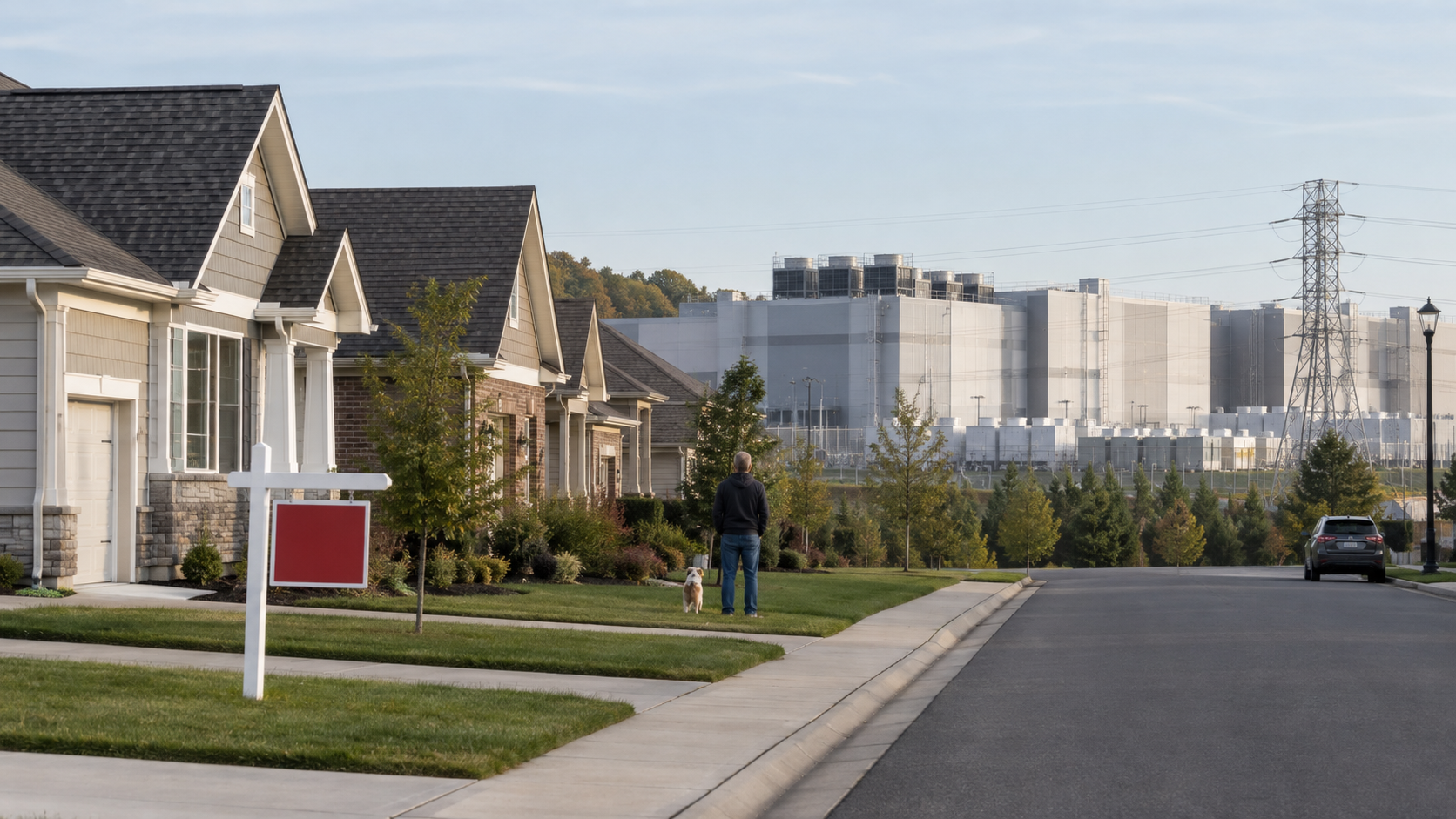
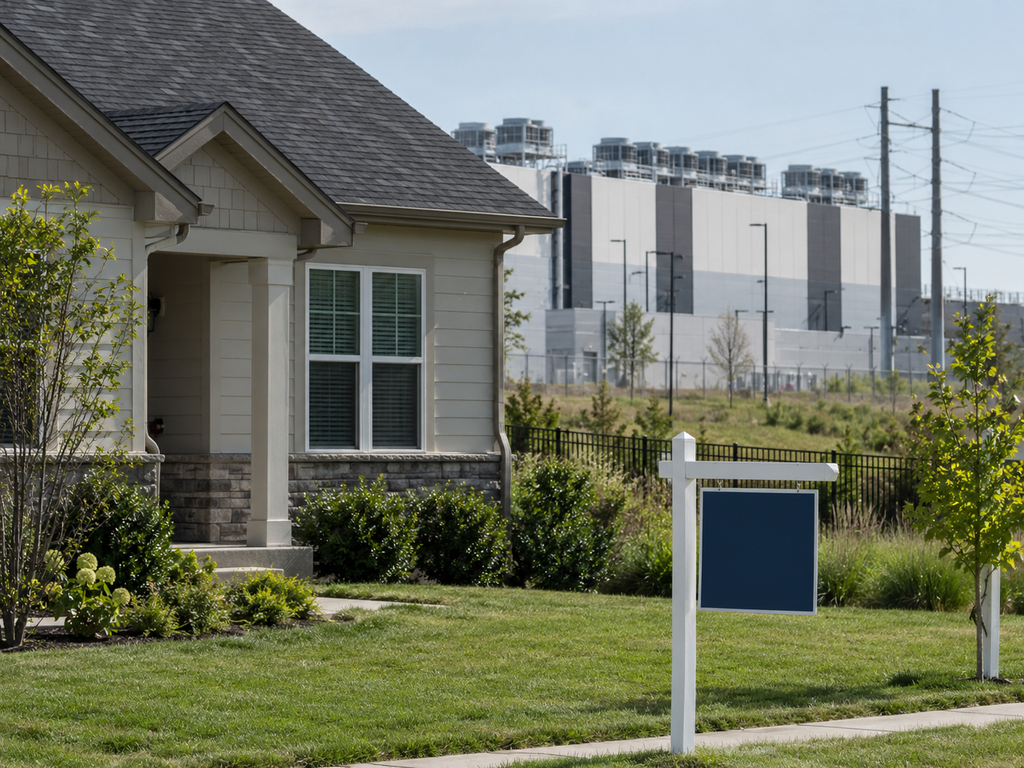
Do data centers lower property values? The research so far says no, not systematically, but “no” is doing a lot of work in that sentence. Several separate studies published in 2025 and 2026 looked at this question using different data, different regions, and different definitions of “data center,” and they didn’t all reach the same conclusion. If you’re weighing whether a proposed facility will hurt your home’s value, the honest answer is that it depends heavily on facility size, distance, and what kind of data center you’re talking about.
This is the same kind of question residents raise at data center town halls, and it pairs naturally with our look at health risks of living near a data center.
The Studies That Found No Negative Effect
The most cited research on this topic comes from George Mason University’s Center for Regional Analysis, part of the Schar School of Policy and Government. Researchers analyzed 2023 home sales data across Northern Virginia, the world’s largest data center market, and compared sale prices to each home’s distance from a facility. They expected to find lower prices closer to data centers. Instead, they found the opposite: homes closer to data centers tended to sell for more, not less, across single family homes, townhouses, and condos alike.
The researchers’ explanation isn’t that data centers themselves raise home values. It’s that data centers tend to get built in places that already have strong infrastructure, good roads, reliable utilities, proximity to jobs and airports, and those same features independently make a neighborhood more attractive to buyers. In the researchers’ own words, the analysis “fails to demonstrate evidence that proximity to a data center negatively impacts housing values.”
A separate 2026 study by real estate consultancy Integra Realty Resources, commissioned as part of a zoning application for a proposed Indiana facility, reached a similar conclusion. Using Zillow data on single family homes within 1.5 miles of four large data centers across four Indiana counties, researchers tracked value changes from 2021 through 2026, spanning the period before, during, and after each facility was built, and found no significant difference in appreciation compared to the surrounding market.
An independent academic working paper using a difference in differences design, a method that compares affected and unaffected areas over time to isolate cause and effect, matched Virginia air permit issuances (a proxy for new data center construction) to zip code level home price data. That analysis, posted to SSRN in early 2026, also found the estimated effects were “economically small and slightly positive,” with confidence intervals ruling out substantial price declines, including for permits tied specifically to AI related facilities.
The Studies That Found a Negative Effect
The picture isn’t unanimous, though, and the disagreement seems to come down to facility type and scale.
A May 2026 National Bureau of Economic Research working paper examined data center growth at the county level nationwide and found the opposite of a negative effect: house prices rose alongside data center growth, along with local employment and business activity, though electricity prices rose too.
But a different nationwide study focused specifically on hyperscale facilities, the largest class of data centers, typically operated by major cloud and AI companies, found a real, measurable decline: home prices near new hyperscale openings fell by an estimated 6.8 percent, with the effect fading out by roughly 14 kilometers from the facility. Notably, the same study found little evidence of a similar effect for smaller, non hyperscale data centers, suggesting scale matters more than data center presence alone.
Why the Studies Disagree
Put together, the pattern that emerges is this: facility size and study scope drive the result more than the mere presence of a data center does.
- Studies looking at established, mixed use data center markets like Northern Virginia, where facilities have coexisted with dense residential development for years, tend to find no negative effect, and sometimes a positive one, largely explained by shared infrastructure quality.
- Studies looking at individual hyperscale campuses, which can run into the hundreds of megawatts and bring more construction disruption, more visible industrial scale, and heavier grid and water demands, are more likely to find a localized, temporary dip in nearby home values.
- County level and regional analyses tend to show net positive effects, because they capture job creation and tax base benefits that offset any localized housing discount near the facility itself.
That’s consistent with what the Realtor.com national analysis found: the share of U.S. home sales within five miles of a large data center has more than doubled since 2018, and home values near recently opened facilities have not shown major changes so far, though the report’s authors caution that the newest wave of hyperscale, AI driven facilities is larger and more intensive than what’s been studied to date, and that the pattern could change.
What This Doesn’t Cover
None of these studies address every scenario residents actually worry about. A few gaps worth knowing about before you draw conclusions for your own situation:
- Transmission line easements are a separate issue from the data center itself. Homeowners in Haymarket, Virginia have fought new transmission lines built specifically to serve nearby data center campuses, which is a distinct property value question from proximity to the facility. An easement or a line crossing your land can affect value in ways a facility a mile away does not.
- None of the available studies look specifically at private well water, groundwater, or private septic systems near data centers, see why data centers use water for the underlying water use mechanics these studies don’t directly measure against property value.
- Construction phase disruption isn’t the same as long term value impact. A study measuring prices after a facility is operational may miss temporary effects during the two to three year construction period.
- Every available study is regional or facility specific. There is no comprehensive national study isolating home values purely by distance to data center across all regions and facility types. Real estate agents interviewed by industry outlets have said local comparable sales data remains more reliable than any single national estimate.
What You Can Actually Check
- Find out the proposed facility’s power capacity. The dividing line in the research so far sits around hyperscale scale campuses (typically 50 or more megawatts) versus smaller facilities, see data centers and the power grid for how capacity figures are reported publicly.
- Ask whether new transmission infrastructure is part of the project, separate from the data center building itself. This is the piece most likely to affect an individual property directly rather than the neighborhood generally.
- Look at comparable sales in other communities with a similar sized facility, ideally one that’s been operating for at least two to three years, rather than relying on a single national percentage.
Practical Summary
The best current evidence, from George Mason University, Integra Realty Resources, and an independent SSRN working paper, shows no systemic negative effect on home values from data center proximity in the markets studied so far, and in some cases a modest positive association tied to shared infrastructure quality. But at least one nationwide study focused specifically on large hyperscale facilities found a measurable, if localized, decline near those bigger campuses. The honest takeaway: facility scale matters more than data centers as a category, the research is still regional and incomplete, and a transmission line tied to a project can matter more to an individual property than the data center building itself.
Frequently Asked Questions
Do data centers lower property values?
The best available research generally finds no systemic negative effect, and in some markets a modest positive association tied to infrastructure quality. One nationwide study focused specifically on large hyperscale facilities found a localized decline of about 6.8 percent near new openings, fading beyond roughly 14 kilometers.
Why did the George Mason study find higher home values near data centers?
Researchers concluded data centers tend to be built in areas that already have strong roads, utilities, and proximity to jobs and airports, features that independently make a neighborhood attractive to buyers, rather than the data center itself raising values.
Does the size of the data center matter?
Yes. Studies looking at hyperscale facilities, generally 50 megawatts or larger, are more likely to find a measurable, localized effect than studies of smaller or mixed use data center markets.
What about a transmission line built to serve a data center?
That’s a separate question from the facility itself. New transmission lines or easements crossing a specific property can affect that property’s value in ways that simply being near a data center a mile away does not.
Is there a single national study I can rely on for my situation?
No. Every study published so far is regional or facility specific: Northern Virginia, Indiana, or a nationwide hyperscale only sample. Local comparable sales data for a similarly sized, similarly aged facility is more reliable than any single national percentage.